
TL;DR
- Supply chain traceability is the ability to track and document a product’s complete journey — from raw material sourcing through manufacturing, distribution, and beyond — supporting compliance, risk management, and brand trust.
- Food and beverage manufacturers face the most stringent traceability requirements, including FDA FSMA Rule 204 (compliance deadline: July 2028) and the EU Deforestation Regulation (EUDR).
- Effective traceability captures Key Data Elements (KDEs) at Critical Tracking Events (CTEs), enabling both forward and backward trace across your supply network.
- The biggest implementation challenges are supplier adoption at tiers 2 and 3, data standardization, and system interoperability.
- Trace One, through its partnerships with Connecting Food and Mondra, helps manufacturers build the traceability and sustainability intelligence infrastructure required for compliance and competitive differentiation.
.png?width=570&height=650&name=Trace%20One_Sustainability%20(4).png)
Business leaders are also starting to recognize that traceability is about more than crisis management. In an environment where consumers increasingly want to know the story behind their products and regulators require documented proof of compliance, traceability has become the digital backbone connecting disparate systems, suppliers, and stakeholders. A holistic view transforms it from a cost center into a competitive advantage that protects margins, accelerates time-to-market, and strengthens relationships with both suppliers and consumers. Learn more about Trace One PLM.
Key TakeawaySupply chain traceability is not just a compliance tool — it is a strategic capability that simultaneously protects consumers, reduces recall costs, satisfies regulatory requirements, and enables the transparency that today’s markets demand. |
Beyond regulatory compliance, robust food traceability protects brand reputation in an era of heightened consumer awareness, supports sustainability claims with verifiable data, enables proactive supplier quality management, and builds trust through transparency that consumers increasingly expect.
Key TakeawayFood traceability is supply chain traceability applied specifically to food products, with stricter regulatory requirements and a stronger focus on public health. The same systems and principles apply — food manufacturers simply operate under a more demanding compliance environment. |

Regulatory Compliance and Risk Mitigation
Regulatory bodies worldwide are tightening traceability requirements. The FDA’s FSMA represents just one example of a broader global trend toward mandatory, digitized tracking. Non-compliance leads to fines, market access restrictions, supply chain disruptions, and even criminal liability in serious cases. Traceability prevents these outcomes by creating an auditable record that demonstrates due diligence and regulatory adherence across every touchpoint in your supply chain.
Recall Efficiency and Cost Containment
When a quality issue arises, speed and precision determine its financial impact. Without the right capabilities, recalls become slow, costly, legally punishing, and reputation-damaging — the delay itself compounds harm. With effective traceability, manufacturers can execute surgical recalls, removing only affected lots rather than pulling entire product lines from shelves. This precision minimizes waste, reduces costs, and accelerates return to normal operations. In best-case scenarios, a recall can be completed before consumers even become aware of the issue, protecting brand equity at the most critical moment.
Brand Protection and Consumer Trust
Consumer behavior research reveals a sobering reality: when a major recall event occurs, more than 60% of consumers avoid entire food categories afterward. In an environment where a single recall can trigger permanent brand abandonment, traceability serves as your first line of defense. It enables transparent communication during crises, demonstrates commitment to safety, and provides the verifiable origin stories that today’s conscious consumers demand.
Operational Excellence
The benefits of supply chain traceability go well beyond regulatory compliance. When integrated into comprehensive product lifecycle management platforms, traceability gives manufacturers the ability to enhance supplier quality management, identify inefficiencies in the supply network, support sustainability reporting with documented proof, and enable data-driven decision-making across procurement, production, and distribution.
Key TakeawayThe financial case for traceability is clear: faster recalls cost less, regulatory penalties are avoided, and brands that provide verifiable transparency command greater consumer trust and loyalty. For food and beverage manufacturers, traceability is a risk mitigation investment with measurable ROI. |

.png?width=570&height=650&name=Trace%20One%20Supply%20Chain%20Traceability%20(1).png)
FSMA Food Traceability Rule (U.S.)
The FDA’s Food Safety Modernization Act (FSMA) Rule 204 — formally the Requirements for Additional Traceability Records for Certain Foods — represents the most significant expansion of U.S. food traceability requirements in decades. The compliance deadline has been extended to July 2028, giving manufacturers additional time to implement required systems. Given the complexity involved, beginning your implementation now is the prudent approach.
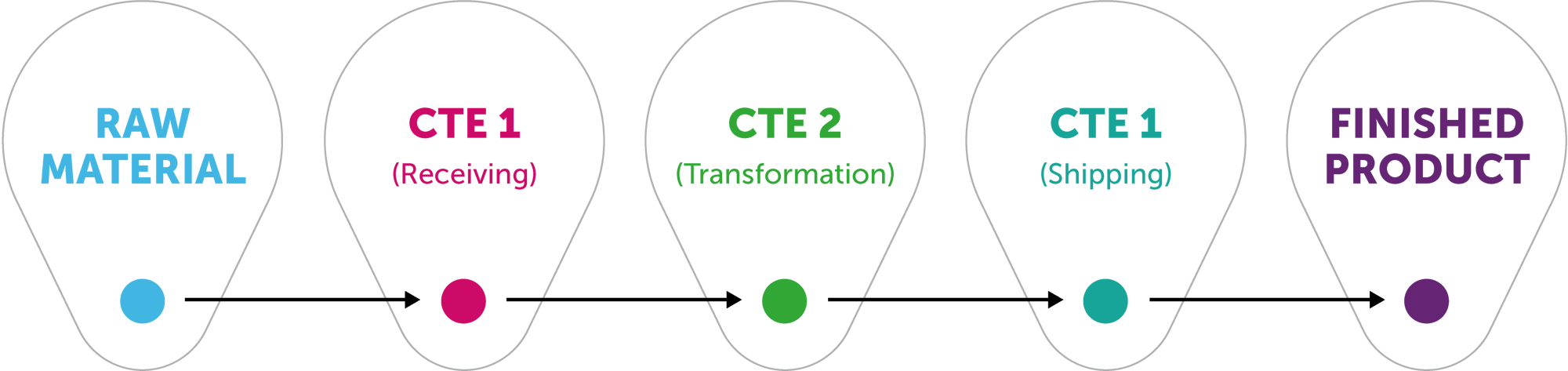
FSMA 204 applies to foods on the Food Traceability List (FTL): products identified as high-risk for foodborne illness outbreaks, including fresh-cut fruits and vegetables, certain cheeses, shell eggs, nut butters, and finfish. For manufacturers working with these commodities, the rule mandates end-to-end lot-level tracking with detailed recordkeeping at Critical Tracking Events (CTEs): harvesting, cooling, initial packing, shipping, receiving, and transformation.
.png?width=570&height=650&name=Trace%20One%20Spec%20Management%20(2).png)
The data requirements center on Key Data Elements (KDEs). While CTEs define the stages where you collect data, KDEs define what you collect: what item you are tracing (the product and lot code), when the record was made, where the item was traced (origin and destination locations), and which business entity is responsible at this step. Companies must be able to provide this information to the FDA within 24 hours of a request — a timeline that makes manual, paper-based systems effectively obsolete.
.png?width=570&height=650&name=Trace%20One%20Devex%20PLM%20PDM%20(2).png)
To meet FDA traceability compliance requirements, manufacturers need integrated digital systems capable of:
- Capturing KDEs at each CTE automatically
- Linking lot codes across transformation steps
- Generating interoperable records shareable with supply chain partners
- Producing FDA-compliant reports on demand within the mandated timeframe
Key TakeawayFSMA 204 compliance requires digital infrastructure — there is no paper-based path to delivering complete, sortable traceability records to the FDA within 24 hours. The July 2028 deadline offers time to implement properly, but not time to delay. |

EU Deforestation Regulation (EUDR)
The European Union Deforestation Regulation (EUDR), which came into effect in June 2023, takes traceability requirements beyond food safety into environmental accountability. The regulation prohibits the sale of products linked to deforestation or forest degradation, applying to seven key commodities frequently used in food and beverage manufacturing — cattle, cocoa, coffee, oil palm, rubber, soy, and wood — as well as derivative products including chocolate, leather, furniture, and paper. See Trace One Sustainability for related packaging and sustainability compliance capabilities.
For each product entering the EU market, companies must provide geolocation coordinates for the commodity’s place of origin and verifiable proof that no deforestation occurred on that land after December 31, 2020. Companies are also responsible for risk assessments, mitigation measures, and comprehensive documentation proving compliance. Non-compliance carries significant penalties under EU law.
Real-world challenge: Cocoa Suppliers in Ghana
The EUDR is particularly challenging for supply chains dependent on smallholder farmers. The primary difficulties center on the high number of intermediaries involved and the lack of technology for tracking and providing evidence about the origins of raw materials and the actors responsible for them. Under Ghana’s pilot programs to geolocate cocoa farms, many producing regions are racing to build the technical infrastructure and farmer training programs necessary to capture and verify data at the farm level. Compliance requires deep visibility into tier-2 and tier-3 suppliers — a level of transparency that many manufacturers simply cannot provide today without dedicated platform support.
Key TakeawayThe EUDR fundamentally expands what traceability means: it is no longer just about food safety, but about proving the environmental provenance of every ingredient. For global manufacturers using cocoa, palm, soy, or other regulated commodities, this requires tier-2 and tier-3 supplier visibility that goes far beyond traditional documentation. |
.png?width=1536&height=1024&name=Trace%20One%20PLM%20Supply%20Chain%20Traceability%20(1).png)

Key Features to Look for in Traceability Software

Your system should generate audit-ready reports aligned with regulatory frameworks like FSMA 204 and EUDR without manual data manipulation. Look for pre-built templates and one-click report generation that enable you to respond to regulatory inquiries within mandated timeframes.

Effective solutions must trace both upstream to raw material origins and downstream to distribution channels. This dual capability enables surgical recalls, rapid root cause analysis, and comprehensive lot genealogy so you can identify all affected products within minutes.

Your traceability solution should integrate with existing ERP, quality management, warehouse management, and product lifecycle management systems. APIs and pre-built connectors eliminate manual data entry, reduce errors, and ensure data flows automatically across your technology ecosystem.

Cloud-based supplier portals allow partners to submit certificates of analysis, upload specifications, provide geolocation data for EUDR compliance, and maintain current certifications. This creates a single source of truth accessible to all authorized stakeholders.

Field teams, quality inspectors, and warehouse personnel need traceability data at the point of activity. Mobile-optimized interfaces enable barcode scanning, on-site data capture, and real-time access to product histories to make traceability practical for frontline operations.

Interoperability makes the difference between a closed silo and a functioning ecosystem. Traceability systems supporting standards like GS1 identifiers improve collaboration with suppliers, customers, and regulators without custom integrations.

Speed is everything during a recall or compliance review. The FDA expects traceability data within 24 hours. Systems with easily configured dashboards enable stakeholders to quickly visualize and communicate product information, minimizing recall scope, reducing costs, and protecting brand reputation.
Challenges in Supply Chain Traceability
While the benefits of supply chain traceability are clear, implementation is genuinely complex. Understanding these barriers upfront helps you plan effectively and select solutions that address real-world obstacles.
Supplier Adoption and Multi-Tier Visibility
One of the most significant traceability challenges lies beyond your direct control: supplier participation. Tier-1 suppliers are relatively manageable, but tier-2 and tier-3 sources — where risks often originate — frequently lack digital infrastructure. Indonesian palm oil suppliers, for example, have flagged significant operational disruption from EUDR enforcement precisely because of fragmented supply chains with limited technology. Smaller suppliers may view traceability requirements as burdensome rather than beneficial, lack technical capabilities, or resist data-sharing requirements entirely..png?width=1536&height=1024&name=Trace%20One%20PLM%20Supply%20Chain%20Traceability%20(3).png)
.png?width=1536&height=1024&name=Trace%20One%20PLM%20Supply%20Chain%20Traceability%20(4).png)
Data Accuracy and Standardization
Traceability systems are only as reliable as the data they contain. Information may arrive in inconsistent formats — PDFs, spreadsheets, or handwritten documents — and errors during manual entry can propagate throughout the supply chain, undermining confidence in the entire record set. Real-time validation capabilities are essential to catching inaccuracies before they compound.
System Interoperability and Cost
Many organizations operate technology ecosystems assembled over decades. Achieving seamless data flow across legacy ERP systems, quality platforms, and warehouse management tools requires robust integration capabilities. Implementation costs extend beyond software licensing to include system integration, supplier onboarding, staff training, and ongoing data management — a combination that can feel prohibitive for mid-sized manufacturers.
Trace One addresses these challenges through its partnership with Connecting Food, which provides dedicated supply chain traceability infrastructure designed to connect manufacturers with their supplier networks. Integrated with Trace One’s PLM and specification management capabilities, this partnership enables manufacturers to extend traceability beyond their direct operations without rebuilding their entire technology stack. See how customers are streamlining supplier quality management with portal technology.
-
Spirits 170+ Countries
Brown-Forman
The 5th largest global spirits company and home of Jack Daniel’s — moved from managing product development through Excel, Word, and electronic file boxes to a unified system where formula data, documentation, and compliance information are contained and generated in one place.
The practical impact is significant: when the U.S. Alcohol and Tobacco Tax and Trade Bureau (TTB) flagged sodium nitrate as a regulated ingredient, Brown-Forman ran a single query in Trace One to identify every affected formula across its entire global portfolio spanning 170+ countries. That single-query traceability capability — across ingredients, formulas, and markets simultaneously — is the kind of response speed that modern regulatory frameworks increasingly demand.
Key capability demonstrated: Global ingredient traceability across complex formulation portfolios without manual reconstruction. -
Food and Beverage
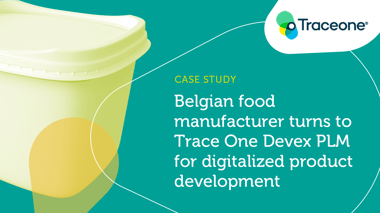
Belgian food manufacturer turns to Trace One Devex PLM for digitalized product development
Discover how Vandemoortele moved from disconnected spreadsheets to a fully digital, centralized PLM system, transforming recipe development and specification management across the organization. By bringing product and supplier data into a single source of truth, it built a stronger foundation for collaboration, data consistency, and end-to-end supply chain visibility.
-

Supplier Collaboration
Optimizing supplier quality management with Trace One's Supplier Collaboration Portal
See how this leading manufacturer replaced fragmented, manual supplier processes with a centralized, integrated solution that improved data accuracy, strengthened collaboration, and streamlined regulatory compliance.
Discover how Trace One’s Supplier Collaboration Portal helped it create a single source of truth and unlock new efficiencies across R&D, FSQ, and beyond.
.png?width=1152&height=768&name=Trace%20One%20PLM%20Supply%20Chain%20Traceability%20(7).png)
How Trace One Supports Traceability
Trace One does not offer supply chain traceability as a standalone capability. What Trace One provides is the product lifecycle management and specification management infrastructure that makes traceability actionable: a unified platform where supplier data, formulations, certifications, and compliance documentation live together, and where regulatory requirements are embedded into product development workflows from day one. This includes master data management capabilities and ERP-PLM integration that connect traceability data across your existing technology stack.
- Connecting Food: Trace One’s partnership with Connecting Food extends traceability capabilities across the supply network, connecting manufacturers with their supplier base and enabling the farm-to-fork visibility that regulations like FSMA 204 and EUDR require.
- Mondra: Trace One’s partnership with Mondra adds carbon footprint measurement and sustainability intelligence to the traceability picture, enabling manufacturers to meet ESG disclosure requirements alongside their food safety and regulatory compliance obligations.
.png?width=1152&height=768&name=Trace%20One%20PLM%20Supply%20Chain%20Traceability%20(6).png)