Trace One | Which Foods Are Most Vulnerable to Import Tariffs?

Which Foods Are Most Vulnerable to Import Tariffs?

| Product Lifecycle Management | Food & Beverage | Blogs
Posted By: Saïda Aït

From morning coffee and orange juice to fresh fruit, seafood, beef, and chocolate, many staples in American kitchens depend heavily on imports. That makes food prices particularly sensitive to changes in U.S. trade policy. Tariffs are taxes collected from U.S. companies when they import goods from abroad, increasing the cost of bringing affected products into the country. While businesses and foreign suppliers can absorb some of that added expense, research from the Federal Reserve has found that the tariffs imposed in 2025 pushed up retail prices, with those increases developing gradually as higher import costs worked their way through supply chains and onto store shelves. For American households, that means tariffs on food and beverages can show up where they are especially difficult to avoid: the grocery bill.

That risk has grown as tariffs have become a central feature of U.S. trade policy under President Donald Trump. Since returning to office in January 2025, Trump has used tariffs to pursue a range of economic and foreign-policy objectives, resulting in new or higher duties on goods from many of the countries that supply American consumers. The specific policies and rates have changed considerably amid negotiations and legal challenges, including a Supreme Court ruling in February 2026 that invalidated tariffs imposed under the International Emergency Economic Powers Act (IEEPA). Following the ruling, the administration temporarily replaced those duties with a 10% Section 122 surcharge, which expired in July 2026 by statutory limit and was succeeded by new Section 301 tariffs of 10% to 12.5%. But tariffs remain at an average effective rate of 6.7% as of July 2026, according to the Penn Wharton Budget Model, which is nearly triple the 2.3% average from before Trump returned to office, and that matters for the food supply. The U.S. imported over $219 billion in agricultural products in 2025, including large quantities of fruits and vegetables, coffee, cocoa, beef, alcoholic beverages, and processed foods. Many of these products are imported because they cannot be grown domestically at sufficient scale, are needed to maintain year-round supplies, or can be produced more economically abroad.

Not every item in the grocery cart is equally exposed. For some foods, imports represent only a small fraction of what Americans consume; for others, foreign suppliers provide a majority of the domestic supply. And because the U.S. sources different foods from different countries, changes in tariffs can affect products—and parts of the country—in very different ways. To better understand that exposure, Trace One—a global provider of AI-native Product Lifecycle Management (PLM) and regulatory compliance software for the food & beverage, cosmetics & personal care, and specialty chemical industries—analyzed the latest data from the U.S. Department of Agriculture (USDA), U.S. Census Bureau, and U.S. Bureau of Economic Analysis to identify the foods most dependent on imports, the countries that supply the largest shares of U.S. food and beverage imports, and the leading food and beverage import in every state.

Key Findings

  • The U.S. agricultural trade deficit reached a record high in 2025. Agricultural imports exceeded exports by $43.7 billion in 2025, up from deficits of $31.9 billion in 2024 and $17.3 billion in 2023.

  • More than half of the U.S. oat supply is expected to come from abroad. Imports accounted for 49.0% of domestic oat consumption in 2025 and are estimated to reach 53.4% in 2026, the highest share among all major agricultural commodities tracked by the USDA.

  • Mexico and Canada dominate U.S. food and beverage imports. The two countries supplied a combined $81.2 billion in 2025, accounting for 37.8% of all U.S. food and beverage imports.
  • Tariff exposure extends well beyond the largest trading partners. Countries with smaller overall shares of U.S. food imports are leading suppliers of major commodities, including Colombian coffee, Australian frozen beef, Indian frozen shrimp and prawns, and Ecuadorian cocoa beans.
  • Coffee and beef are the most common top food import across the states. Unroasted coffee and fresh, frozen, or preserved beef rank as the leading food and beverage imports in seven states, each.

Is the U.S. Agricultural Trade Deficit Getting Worse?

The U.S. agricultural trade deficit hit a record $43.7B in 2025

Combo chart showing U.S. exports and imports as lines and the net trade balance as columns from 1990 to 2027, illustrating the shift from a trade surplus to a widening deficit after 2019.


Source: Trace One analysis of USDA data

Details
U.S. Trade Balance Over Time
Year Exports Imports Net trade balance
1990$45,348,000,000$23,816,000,000$21,532,000,000
1991$43,459,000,000$23,819,000,000$19,640,000,000
1992$47,156,000,000$25,844,000,000$21,312,000,000
1993$47,934,000,000$25,920,000,000$22,014,000,000
1994$49,495,000,000$27,907,000,000$21,588,000,000
1995$60,958,000,000$30,480,000,000$30,478,000,000
1996$65,873,000,000$33,421,000,000$32,452,000,000
1997$63,068,000,000$37,192,000,000$25,876,000,000
1998$59,401,000,000$38,832,000,000$20,569,000,000
1999$53,755,000,000$39,741,000,000$14,014,000,000
2000$55,294,000,000$41,646,000,000$13,648,000,000
2001$56,701,000,000$42,214,000,000$14,487,000,000
2002$55,964,000,000$44,457,000,000$11,507,000,000
2003$58,662,000,000$49,114,000,000$9,548,000,000
2004$64,896,000,000$56,127,000,000$8,769,000,000
2005$64,859,000,000$61,567,000,000$3,292,000,000
2006$71,231,000,000$68,868,000,000$2,363,000,000
2007$85,227,000,000$75,171,000,000$10,056,000,000
2008$117,951,000,000$84,227,000,000$33,724,000,000
2009$98,644,000,000$78,241,000,000$20,403,000,000
2010$111,239,000,000$82,934,000,000$28,305,000,000
2011$142,090,000,000$97,465,000,000$44,625,000,000
2012$141,200,000,000$108,342,000,000$32,858,000,000
2013$145,082,000,000$111,002,000,000$34,080,000,000
2014$156,849,000,000$115,888,000,000$40,961,000,000
2015$144,068,000,000$121,611,000,000$22,457,000,000
2016$133,719,000,000$121,083,000,000$12,636,000,000
2017$144,781,000,000$127,151,000,000$17,630,000,000
2018$148,620,000,000$136,478,000,000$12,142,000,000
2019$140,094,000,000$141,437,000,000-$1,343,000,000
2020$139,724,000,000$143,403,000,000-$3,679,000,000
2021$171,833,000,000$163,322,000,000$8,511,000,000
2022$196,016,000,000$194,127,000,000$1,889,000,000
2023$178,029,000,000$195,303,000,000-$17,274,000,000
2024$174,119,000,000$206,065,000,000-$31,946,000,000
2025$175,615,000,000$219,361,000,000-$43,746,000,000
2026*$179,500,000,000$204,500,000,000-$25,000,000,000
2027*$186,500,000,000$211,000,000,000-$24,500,000,000


The growing importance of imported food is evident in the nation’s agricultural trade balance. For most of the past three decades, the U.S. exported more agricultural products than it imported. But that longstanding pattern has reversed—and the gap has widened rapidly in recent years.

In 2025, U.S. agricultural imports reached a record $219.4 billion, while exports totaled just $175.6 billion, resulting in a record $43.7 billion trade deficit when using the unrounded data. That was up from $31.9 billion in 2024 and $17.3 billion in 2023. The reversal is particularly notable given that the U.S. recorded agricultural trade surpluses exceeding $40 billion as recently as 2011 and 2014. The balance first moved into deficit in 2019, briefly returned to surplus in 2021 and 2022, and has remained negative since 2023 as imports have outpaced exports.

The deficit is projected to narrow over the next two years but remain historically large. The current forecasts put agricultural exports at $179.5 billion in 2026 and $186.5 billion in 2027, compared with imports of $204.5 billion and $211.0 billion, respectively. That would reduce the trade deficit to $25.0 billion in 2026 and $24.5 billion in 2027—a significant improvement from the 2025 record, but still a major departure from the trade surpluses that characterized much of the past three decades.

Which U.S. Foods Depend Most on Imports?

Half of all oats consumed in the U.S. are imported
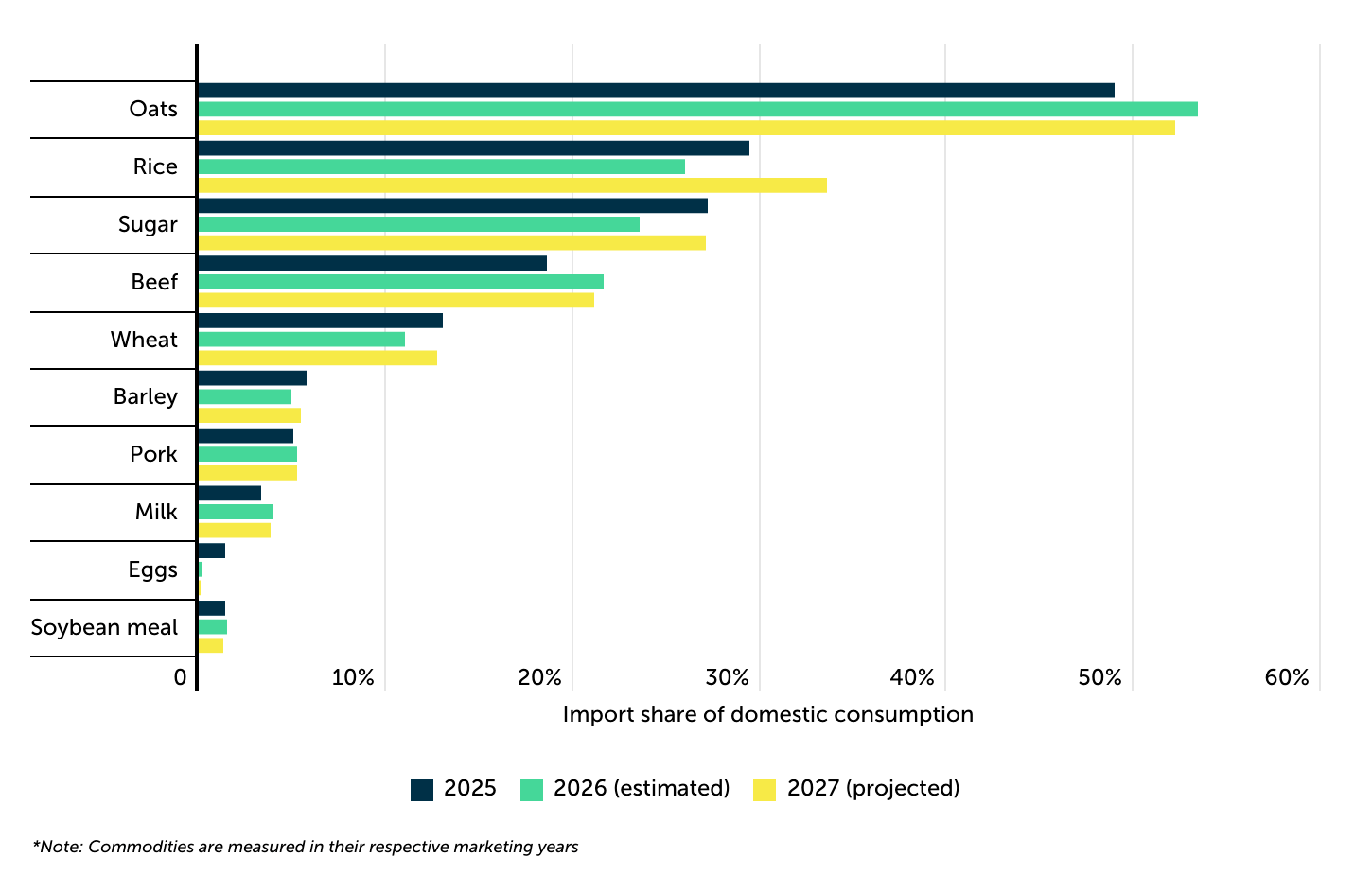
Grouped bar chart showing the share of U.S. domestic consumption supplied by imports for major food commodities in 2025, with estimates for 2026 and projections for 2027, led by oats, rice, and sugar.

Source: Trace One analysis of USDA data

Details
U.S. Food Import Dependence by Commodity
Commodity 2025 import share 2026 import share (estimated) 2027 import share (projected)
Oats 49.0% 53.4% 52.2%
Rice 29.4% 26.0% 33.6%
Sugar 27.2% 23.6% 27.1%
Beef 18.6% 21.7% 21.1%
Wheat 13.1% 11.0% 12.7%
Barley 5.8% 5.0% 5.5%
Pork 5.1% 5.3% 5.3%
Milk 3.3% 3.9% 3.8%
Eggs 1.4% 0.2% 0.1%
Soybean meal 1.4% 1.5% 1.3%


The widening agricultural trade deficit shows how important foreign suppliers have become to the U.S. food system, but that dependence is much greater for some commodities than others. Among the major agricultural commodities analyzed, oats are the most dependent on imports: foreign supplies accounted for 49.0% of U.S. consumption in 2025, and that share is estimated to rise to 53.4% in 2026. This level of import dependence does not mean those supplies are necessarily subject to tariffs today, but it does make the commodities more vulnerable to changes in trade policy that raise the cost or restrict the availability of foreign goods.

The U.S. reliance on foreign oats largely reflects a long-term decline in domestic production. American farmers have shifted acreage away from oats toward crops such as corn and soybeans, while Canada has developed into the dominant supplier to the U.S. market. Rice and sugar follow oats, with imports accounting for 29.4% and 27.2% of domestic consumption, respectively, in 2025. Rice dependence is projected to increase to 33.6% by 2027, driven by a combination of lower U.S. production and continued demand for imported varieties—particularly aromatic rice, such as jasmine and basmati, that are predominantly supplied by Asian producers. Sugar imports, meanwhile, are a longstanding component of the U.S. market, supplementing domestic cane and beet sugar production under a federal program that regulates how much foreign sugar can enter the country at lower tariff rates.

Beef is another commodity where reliance on foreign supply is expected to grow. Imports accounted for 18.6% of U.S. beef consumption in 2025, rising to an estimated 21.7% in 2026 and a projected 21.1% in 2027. The increase comes as the U.S. cattle herd remains near historically low levels following years of drought, high production costs, and herd reductions, constraining domestic beef supplies even as consumer demand remains strong. The U.S. also imports lean beef used primarily in ground beef production, complementing the fattier beef produced domestically. Together, these patterns illustrate an important source of tariff vulnerability: when domestic production cannot readily replace foreign supply, tariffs or other trade disruptions affecting major suppliers have greater potential to work their way through the food supply chain and ultimately into consumer prices.


RELATED

When an imported ingredient costs more or becomes harder to source, food manufacturers often need to adjust their recipes. Trace One's AI-native PLM platform connects formulation, specifications, and supplier collaboration in one place. Learn more about PLM software for food manufacturers.

New call-to-action


Which Countries Supply the Most Food and Beverage Imports to the U.S.?

Food & beverage imports from Mexico & Canada account for 38% of the U.S. total
 

Source: Trace One analysis of USDA data

Details

U.S. Food and Beverage Import Sources

Country of origin Total U.S. food imports from country of origin Group
Mexico $43,458,808,892 $10B+
Canada $37,754,025,433 $10B+
Italy $8,121,710,976 $5–$9.9B
Brazil $7,750,238,539 $5–$9.9B
Australia $6,618,549,462 $5–$9.9B
Chile $6,218,718,544 $5–$9.9B
France $5,942,426,123 $5–$9.9B
Indonesia $5,911,273,244 $5–$9.9B
Peru $5,631,299,624 $5–$9.9B
India $5,615,874,475 $5–$9.9B
Vietnam $5,131,638,185 $5–$9.9B
China $4,860,958,453 $2–$4.9B
Colombia $4,488,248,178 $2–$4.9B
Ecuador $4,264,410,997 $2–$4.9B
Thailand $4,067,805,209 $2–$4.9B
Spain $3,616,918,459 $2–$4.9B
New Zealand $3,524,662,968 $2–$4.9B
Guatemala $3,013,720,960 $2–$4.9B
Netherlands $2,873,478,360 $2–$4.9B
United Kingdom $2,450,910,395 $2–$4.9B
Singapore $2,367,930,839 $2–$4.9B
Argentina $2,301,488,605 $2–$4.9B
Germany $2,111,170,233 $2–$4.9B
Korea, South $2,099,715,854 $2–$4.9B
Costa Rica $2,096,006,837 $2–$4.9B
Turkey $1,929,887,261 $1–$1.9B
Malaysia $1,783,677,925 $1–$1.9B
Switzerland $1,766,922,867 $1–$1.9B
Norway $1,742,468,766 $1–$1.9B
Japan $1,723,925,990 $1–$1.9B
Cote d'Ivoire $1,602,435,563 $1–$1.9B
Philippines $1,596,805,132 $1–$1.9B
Honduras $1,449,375,167 $1–$1.9B
Belgium $1,262,309,020 $1–$1.9B
Ireland $1,211,678,090 $1–$1.9B
Nicaragua $1,112,859,128 $1–$1.9B
Uruguay $1,063,786,257 $1–$1.9B
Poland $928,535,577 $100M–$999M
Dominican Republic $877,999,221 $100M–$999M
Greece $847,704,572 $100M–$999M
Ghana $772,127,828 $100M–$999M
Taiwan $693,659,661 $100M–$999M
Denmark $578,912,589 $100M–$999M
South Africa $543,529,077 $100M–$999M
Egypt $519,705,771 $100M–$999M
Israel $448,614,496 $100M–$999M
El Salvador $407,645,256 $100M–$999M
Paraguay $390,406,868 $100M–$999M
Tunisia $378,093,740 $100M–$999M
Iceland $368,146,314 $100M–$999M
Morocco $355,503,718 $100M–$999M
Ethiopia $336,285,708 $100M–$999M
Sri Lanka $300,651,281 $100M–$999M
Portugal $277,602,637 $100M–$999M
Faroe Islands $265,210,277 $100M–$999M
Ukraine $226,124,364 $100M–$999M
Austria $224,975,173 $100M–$999M
Pakistan $207,830,639 $100M–$999M
Jamaica $202,522,149 $100M–$999M
Sweden $200,937,159 $100M–$999M
Fiji $195,105,575 $100M–$999M
Venezuela $194,106,277 $100M–$999M
Uganda $185,599,639 $100M–$999M
Kenya $172,941,708 $100M–$999M
Nigeria $172,692,095 $100M–$999M
Cameroon $170,265,952 $100M–$999M
Panama $159,617,374 $100M–$999M
Bulgaria $148,555,456 $100M–$999M
Croatia $139,074,218 $100M–$999M
United Arab Emirates $135,411,781 $100M–$999M
Latvia $107,812,416 $100M–$999M
Bolivia $93,182,048 <$100M
Bahamas $91,443,422 <$100M
Hong Kong $81,726,724 <$100M
Tanzania $80,129,778 <$100M
Madagascar $79,912,096 <$100M
Jordan $79,297,584 <$100M
Slovenia $76,633,841 <$100M
Papua New Guinea $76,069,321 <$100M
Lithuania $74,710,137 <$100M
Lebanon $73,136,207 <$100M
Serbia $68,806,765 <$100M
Hungary $65,120,534 <$100M
Trinidad and Tobago $62,173,053 <$100M
Czech Republic $49,896,466 <$100M
Bangladesh $49,307,669 <$100M
Cambodia $48,582,702 <$100M
Belize $48,025,203 <$100M
Saudi Arabia $47,761,866 <$100M
Russia $47,153,862 <$100M
Mauritius $43,965,358 <$100M
Suriname $39,810,595 <$100M
Burma $37,578,472 <$100M
Albania $35,469,104 <$100M
Finland $34,831,434 <$100M
Reunion $31,751,652 <$100M
Moldova $31,053,195 <$100M
Senegal $30,912,601 <$100M
Greenland $29,258,169 <$100M
Guyana $28,039,164 <$100M
Barbados $26,805,687 <$100M
Zambia $23,774,538 <$100M
Rwanda $23,437,090 <$100M
Estonia $23,078,648 <$100M
Mongolia $22,867,080 <$100M
Falkland Islands (Islas Malvinas) $20,857,089 <$100M
Kazakhstan $20,764,778 <$100M
Cyprus $20,185,308 <$100M
Haiti $18,898,546 <$100M
Malawi $18,653,308 <$100M
Afghanistan $17,563,289 <$100M
Oman $17,488,323 <$100M
Eswatini $17,362,871 <$100M
Georgia $16,865,800 <$100M
Romania $16,634,902 <$100M
Armenia $16,445,974 <$100M
Vanuatu $15,842,922 <$100M
Chad $15,272,528 <$100M
Uzbekistan $14,035,424 <$100M
North Macedonia $13,950,665 <$100M
Zimbabwe $13,230,856 <$100M
Marshall Islands $12,844,986 <$100M
Algeria $12,277,134 <$100M
Timor-Leste $11,988,811 <$100M
Mozambique $11,695,850 <$100M
Slovakia $11,535,294 <$100M
Sudan $11,438,748 <$100M
Grenada $10,422,790 <$100M
French Polynesia $10,235,511 <$100M
Burundi $7,994,646 <$100M
Montenegro $7,832,625 <$100M
Namibia $7,562,940 <$100M
Belarus $7,554,665 <$100M
Togo $7,498,804 <$100M
Bahrain $6,868,986 <$100M
Benin $6,247,079 <$100M
Nepal $6,186,453 <$100M
Yemen $6,003,852 <$100M
St Helena $5,900,561 <$100M
Bosnia and Herzegovina $4,880,681 <$100M
Burkina Faso $4,492,187 <$100M
Syria $4,115,360 <$100M
West Bank Administered by Israel $3,909,218 <$100M
Sierra Leone $3,766,772 <$100M
Luxembourg $3,288,178 <$100M
Macau $3,145,916 <$100M
Azerbaijan $2,946,184 <$100M
Samoa $2,873,282 <$100M
Turks and Caicos Islands $2,827,710 <$100M
Maldives $2,780,621 <$100M
Cabo Verde $2,607,679 <$100M
Laos $2,432,999 <$100M
South Sudan $2,205,700 <$100M
Kosovo $2,170,304 <$100M
St Lucia $2,169,446 <$100M
Iraq $2,144,841 <$100M
New Caledonia $2,120,637 <$100M
Mali $2,106,109 <$100M
St Vincent and the Grenadines $1,730,559 <$100M
French Guiana $1,336,319 <$100M
San Marino $1,284,214 <$100M
Solomon Islands $1,213,708 <$100M
Bermuda $1,171,361 <$100M
Guinea $1,040,844 <$100M
Kuwait $1,035,158 <$100M
Monaco $928,215 <$100M
Lesotho $905,999 <$100M
Martinique $904,241 <$100M
British Virgin Islands $900,000 <$100M
Kiribati $789,258 <$100M
Seychelles $716,866 <$100M
Democratic Republic of Congo $694,068 <$100M
Liberia $625,276 <$100M
Comoros $600,358 <$100M
Kyrgyzstan $599,767 <$100M
Congo $590,381 <$100M
Djibouti $572,888 <$100M
Niger $565,789 <$100M
Somalia $556,150 <$100M
Tonga $530,060 <$100M
St Kitts and Nevis $425,927 <$100M
Turkmenistan $296,786 <$100M
Malta $295,094 <$100M
Palau $276,670 <$100M
Antigua and Barbuda $273,970 <$100M
Mauritania $222,281 <$100M
Gambia $213,514 <$100M
Brunei $207,043 <$100M
Angola $198,454 <$100M
Anguilla $198,113 <$100M
Tajikistan $193,615 <$100M
Cayman Islands $170,528 <$100M
Dominica $141,872 <$100M
Micronesia $139,769 <$100M
Libya $132,525 <$100M
Sint Maarten $122,835 <$100M
Central African Republic $121,438 <$100M
Curacao $102,478 <$100M
Andorra $99,226 <$100M
Botswana $98,430 <$100M
Aruba $97,143 <$100M
Eritrea $63,883 <$100M
Qatar $60,187 <$100M
Iran $52,774 <$100M
Sao Tome and Principe $47,135 <$100M
Bhutan $44,055 <$100M
Mayotte $18,628 <$100M
Cook Islands $12,843 <$100M
Christmas Island $2,643 <$100M

Top Imported Food Commodities

Food commodity Annual imports Top country
Coffee (not roasted) $9,690,907,562 Colombia
Bread & pastries $7,401,572,922 Canada
Beef (frozen) $6,137,654,372 Australia
Prepared foods $6,040,724,350 Singapore
Beef (fresh) $5,673,270,054 Canada
Shrimp & prawns (frozen) $4,936,006,356 India
Avocados $3,656,452,928 Mexico
Candies (non-cocoa) $3,104,060,107 Mexico
Tomatoes $2,847,479,076 Mexico
Cocoa beans $2,782,074,533 Ecuador

Top Imported Beverage Commodities

Beverage commodity Annual imports Top country
Beer $7,016,175,052 Mexico
Wine $4,302,700,453 France
Other spirits (tequila, mezcal, & others) $3,845,929,693 Mexico
Sparkling wine $1,621,145,836 France
Flavored waters $1,484,070,464 Mexico
Whiskies $1,438,589,016 United Kingdom
Milks, fortified juices, & other nonalcoholic drinks $1,252,111,504 Mexico
Liqueurs & cordials $1,236,804,818 Canada
Tropical, stone fruit, & vegetable juices $1,215,459,101 Thailand
Orange juice $923,629,519 Brazil


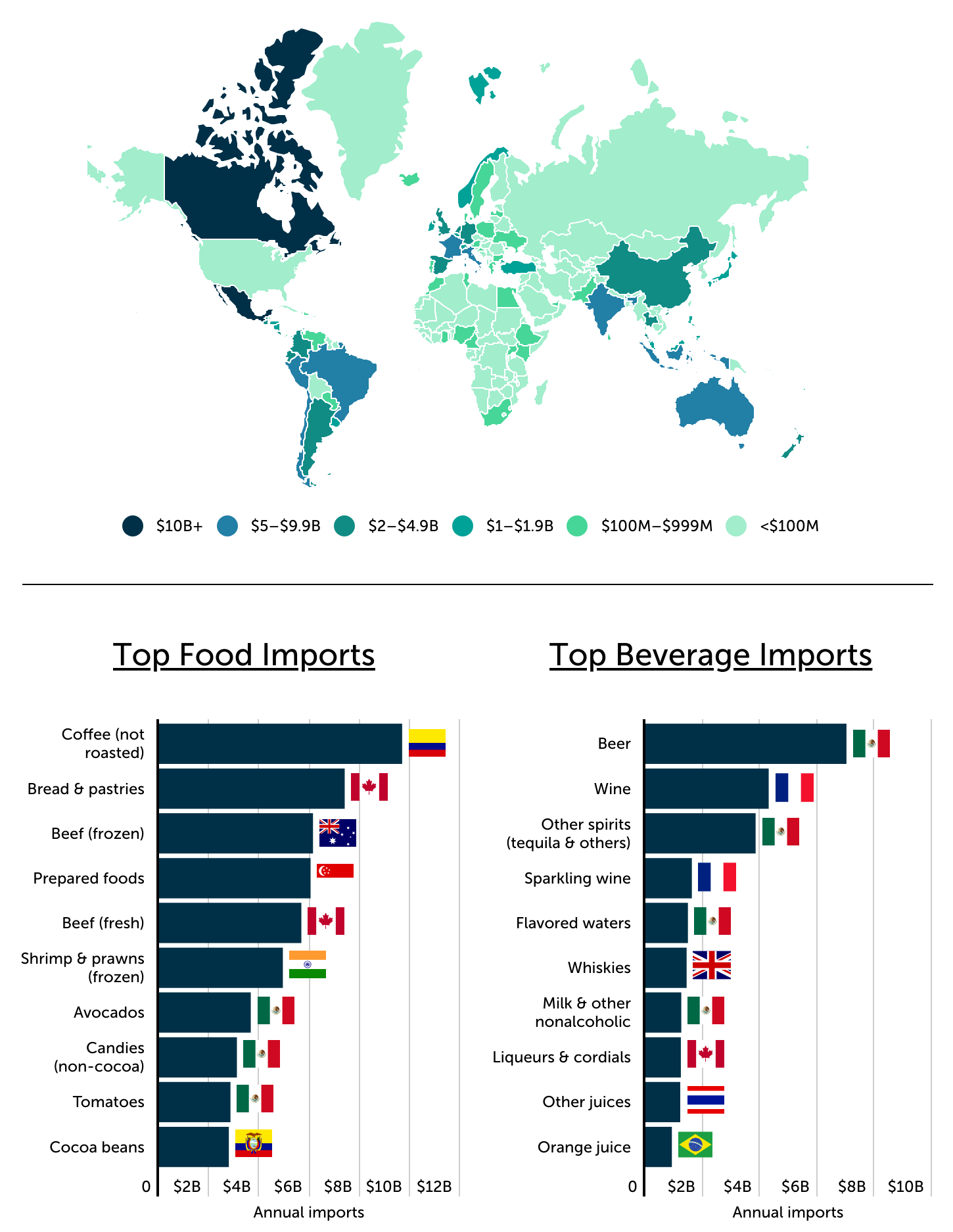
The potential impact of tariffs depends not only on how much food the U.S. imports, but also on where those imports originate. In 2025, the U.S. imported $214.9 billion in food and beverages—accounting for 98% of all agricultural imports in the U.S.—with more than one-third coming from its two closest neighbors. Mexico supplied $43.5 billion and Canada $37.8 billion (after rounding), together accounting for 37.8% of the U.S. total. No other individual country came close: Italy ranked third at $8.1 billion, followed by Brazil at $7.8 billion and Australia at $6.6 billion.

The concentration of trade with Mexico and Canada is especially important because both countries lead major food and beverage categories consumed across the U.S. Mexico is the leading source of four separate beverage commodity categories, including beer—the largest beverage import category. Mexico also supplies the most foreign avocados, non-cocoa candies, and tomatoes in terms of customs value. Meanwhile, Canada leads U.S. imports of bread and pastries, fresh beef, and liqueurs and cordials. These relationships reflect deeply integrated North American supply chains developed under NAFTA and continued under the United States-Mexico-Canada Agreement (USMCA). They also mean that changes in tariff policy toward either country have the potential to affect a broad range of products found in grocery stores, restaurants, and bars.

Other countries are similarly important within specific categories. Colombia is the leading source of unroasted coffee, Australia leads frozen beef, India leads frozen shrimp and prawns, and Ecuador leads cocoa beans. France is the top supplier of both wine and sparkling wine, while the United Kingdom leads whisky imports. This concentration illustrates another source of tariff vulnerability: even countries that represent a relatively small share of total U.S. food and beverage imports can be critical suppliers of individual products. As a result, tariffs targeted at particular countries or commodities can have a much larger effect on specific foods and beverages than their share of overall imports might suggest.

For U.S. food and beverage manufacturers, tariff exposure requires making strategic decisions about the products themselves, not just accounting for higher expenses. When an imported ingredient becomes more expensive or harder to source, companies can either absorb the additional costs, raise prices, switch suppliers, or reformulate their products. Switching suppliers means qualifying a new source and checking every specification, while reformulating recipes means updating specifications, checking compliance, and changing labels. For ingredients like oats, where imports covered 49.0% of U.S. consumption in 2025, the effects of those decisions can reach grocery store shelves very quickly.

"Switching suppliers to avoid a tariff is never just a purchasing decision. Every new source has to be qualified, every specification checked, and every label still has to be right. Tariffs turn sourcing into a product development problem."
Saïda Aït, VP Global Marketing, Trace One


RELATED

Every new supplier or recipe change has to stay compliant, from specifications to labels. Trace One combines PLM with integrated regulatory intelligence spanning 170+ countries. Learn more about product lifecycle management for food and beverage manufacturers.


What Is the Top Food and Beverage Import in Every State?
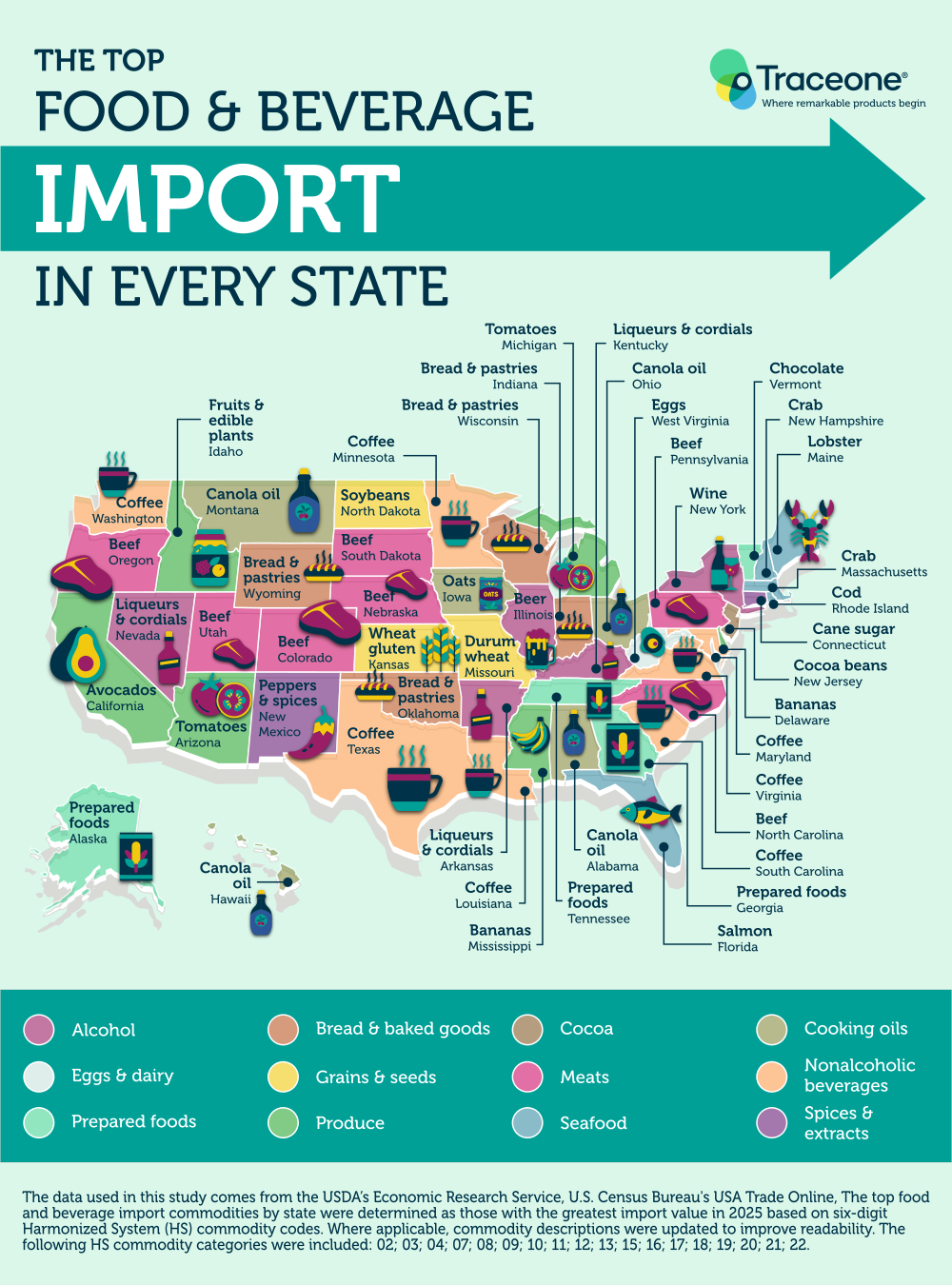
  

The top food and beverage imports by state vary greatly, spanning everything from cooking oils and prepared foods to meats, seafood, fresh produce, and alcohol. Coffee and beef rank as the leading imports in seven states each, while the bread and pastries category and canola oil each lead in four states. Prepared foods and the liqueurs and cordials grouping each rank first in three states. Interestingly, despite beer being the top imported beverage nationally, Illinois remains the only state where it ranks as the number one state-level import.

For a broader view of the domestic market, see our Food & Beverage Manufacturing Industry Statistics.

Full Results

 
Details
Rank State Total food imports State share of total U.S. food imports Top food import Share of households receiving food stamps (SNAP) Food share of average household budget Households facing food insecurity
1California$40,390,163,06018.80%Avocados13.50%13.60%12.50%
2New Jersey$30,416,004,70114.20%Cocoa beans9.10%12.00%9.80%
3Texas$21,356,268,2099.90%Coffee (not roasted)10.30%14.40%17.60%
4Florida$17,481,776,7588.10%Salmon11.40%13.80%13.30%
5Illinois$15,164,805,4277.10%Beer13.40%12.90%13.30%
6Pennsylvania$13,617,182,3786.30%Beef (frozen)15.10%12.00%10.90%
7New York$13,147,145,4216.10%Wine16.20%12.40%14.00%
8Georgia$8,973,622,1554.20%Prepared foods10.80%14.60%14.60%
9Massachusetts$4,831,848,9992.20%Crabs (frozen)15.10%12.40%11.70%
10Maryland$4,258,667,5022.00%Coffee (not roasted)10.30%12.30%11.50%
11Arizona$4,078,599,3331.90%Tomatoes10.20%13.00%13.10%
12Louisiana$4,003,340,2531.90%Coffee (not roasted)16.70%14.30%17.70%
13Washington$3,999,823,8771.90%Coffee (not roasted)11.10%12.60%11.00%
14Virginia$3,344,435,2651.60%Coffee (not roasted)9.20%13.50%12.40%
15Michigan$2,969,545,0341.40%Tomatoes13.20%12.70%14.70%
16South Carolina$2,281,952,4801.10%Coffee (not roasted)9.50%14.30%13.50%
17Ohio$2,137,768,7271.00%Canola oil11.60%13.40%14.20%
18Indiana$2,065,001,3531.00%Bread & pastries8.60%13.30%13.70%
19Wisconsin$1,481,211,1750.70%Bread & pastries11.00%12.50%12.00%
20Minnesota$1,389,542,6160.60%Coffee (not roasted)8.30%11.60%9.90%
21Delaware$1,318,051,1650.60%Bananas10.00%12.80%10.80%
22North Carolina$1,317,574,6170.60%Beef12.00%14.00%11.80%
23Kentucky$1,275,679,8210.60%Liqueurs & cordials13.40%14.60%18.80%
24Missouri$1,032,082,2140.50%Durum wheat9.30%13.00%13.30%
25Connecticut$987,165,2340.50%Cane sugar11.90%11.70%12.10%
26Oregon$918,492,3980.40%Beef16.40%14.60%12.50%
27Vermont$823,190,5730.40%Chocolate10.60%13.00%9.40%
28Iowa$678,773,8600.30%Oats8.20%13.60%10.80%
29Colorado$676,184,0940.30%Beef8.90%14.00%10.50%
30Tennessee$669,791,1510.30%Prepared foods9.40%13.30%13.30%
31Maine$619,902,2900.30%Lobster12.70%14.10%12.90%
32Utah$540,936,6580.30%Beef4.60%12.30%11.50%
33Kansas$479,521,4240.20%Wheat gluten5.90%14.40%12.50%
34North Dakota$452,622,8540.20%Soybeans6.40%11.20%9.00%
35New Hampshire$432,945,7460.20%Crabs (frozen)6.50%13.20%9.10%
36Nevada$430,034,2310.20%Liqueurs & cordials11.90%13.60%15.00%
37Alabama$401,548,5940.20%Canola oil13.10%14.20%12.10%
38Idaho$369,220,8680.20%Potatoes (frozen)7.20%13.00%12.60%
39Rhode Island$319,697,8860.10%Cod (frozen)13.90%14.80%10.60%
40Nebraska$310,877,4650.10%Beef8.40%12.60%12.70%
41Mississippi$296,797,7690.10%Bananas11.90%15.60%17.30%
42Arkansas$289,939,4910.10%Liqueurs & cordials9.00%13.40%19.40%
43Hawaii$284,672,7660.10%Canola oil11.50%15.60%10.80%
44South Dakota$276,030,9930.10%Beef (preserved)7.10%12.10%9.50%
45Montana$210,570,0390.10%Canola oil7.00%13.60%11.70%
46New Mexico$200,500,2080.10%Peppers & spices (fresh)19.30%14.80%14.50%
47Oklahoma$101,928,1760.00%Bread & pastries14.00%13.40%16.90%
48Wyoming$60,765,9360.00%Bread & pastries5.60%13.90%15.60%
49Alaska$16,284,5870.00%Prepared foods10.40%13.10%13.00%
50West Virginia$14,054,2790.00%Eggs17.00%13.30%14.10%


Rank Country of origin Total U.S. food imports from country of origin Country of origin share of total U.S. food imports Top Export to U.S.


FAQ


Q: Which agricultural commodity is the U.S. most dependent on imports?

Oats, with imports accounting for 49.0% of U.S. consumption in 2025 and an estimated 53.4% in 2026.

Q: Which countries supply the most U.S. food and beverage imports?

Mexico and Canada, which supplied a combined $81.2 billion, or 37.8% of U.S. food and beverage imports, in 2025.

Q: Which foods are the most common top imports across U.S. states?

Unroasted coffee and fresh, frozen, or preserved beef are tied as the most common top food and beverage imports, ranking first in seven states each.

Q: What was the U.S. agricultural trade deficit in 2025?

The U.S. agricultural trade deficit reached a record $43.7 billion in 2025, as agricultural imports totaled $219.4 billion compared with $175.6 billion in exports (Note: values do not sum to total due to rounding).

Methodology

The data used in this study comes from the USDA’s Economic Research Service, U.S. Census Bureau's USA Trade Online, U.S. Census Bureau’s American Community Survey, and U.S. Bureau of Economic Analysis’s Consumer Spending by State.

The top food and beverage import commodities for the U.S. overall, by country, and by state were determined as those with the greatest import value in 2025 based on six-digit Harmonized System (HS) commodity codes. Where applicable, commodity descriptions were updated to improve readability. The following HS commodity categories were included: 02; 03; 04; 07; 08; 09; 10; 11; 12; 13; 15; 16; 17; 18; 19; 20; 21; 22.

The share of households receiving food stamps (SNAP) was sourced from the 2024 American Community Survey, food insecurity data from the USDA covers the period from 2022 to 2024, and consumer spending data from the Bureau of Economic Analysis is from 2025.