What Packaging Data Do Beauty Brands Need for PPWR and US EPR?
|
Packaging
|
Cosmetics
|
PPWR
Posted By:
Claudia Boselli, Regulatory Expert, Trace One
In brief
The EU’s Packaging and Packaging Waste Regulation (PPWR) and the packaging extended producer responsibility (EPR) laws in seven US states ask beauty brands for the same foundation: accurate data on every component of every pack, linked to the products and markets where it is sold. In the EU, that data decides whether packaging can be placed on the market and drives EPR fees in each Member State. In the US, it drives state EPR fees. A brand that keeps one packaging dataset can answer both.
In This Guide
- What is packaging EPR in the US?
- Which US states have packaging EPR laws?
- Who counts as the producer under US EPR?
- What packaging data do US EPR programs ask for?
- What packaging data does PPWR ask for?
- What data do PPWR and US EPR have in common?
- Why do beauty brands find packaging data hard to manage?
- How can one packaging dataset cover PPWR and US EPR?
What is packaging EPR in the US?
Packaging extended producer responsibility makes the companies that sell packaged products pay for collecting and recycling that packaging, instead of local governments and taxpayers. In practice, producers join a producer responsibility organization, report the packaging they sell into each state, and pay fees based on that report.
Seven states have passed packaging EPR laws, covering roughly one in five Americans. With the exception of Maine, in every state with an approved program so far, the producer responsibility organization is Circular Action Alliance (CAA). Maine follows a different model and has not yet contracted its stewardship organization.
Which US states have packaging EPR laws?
Oregon, Colorado, California, Maine, Minnesota, Maryland and Washington. Their status as of November 2026:
| State | Law | Enacted | Where it stands | Producer responsibility organization |
|---|---|---|---|---|
| Oregon | Plastic Pollution and Recycling Modernization Act (SB 582) | 2021 | Program changes started in July 2025. Since May 31, 2026, supply data for the prior year is due to CAA by May 31 each year | Circular Action Alliance |
| Colorado | HB22-1355 | 2022 | Producer fees started in January 2026 | Circular Action Alliance |
| California | SB 54, Plastic Pollution Prevention and Packaging Producer Responsibility Act | 2022 | Permanent regulations approved May 1, 2026. CAA’s program plan submitted October 13, 2026. CAA issued early-fee invoices in 2026 to cover pre-program costs | Circular Action Alliance |
| Maine | Stewardship Program for Packaging (38 M.R.S. § 2146) | 2021, amended 2025 | No stewardship organization contracted yet. Schedule under review | To be selected |
| Minnesota | Packaging Waste and Cost Reduction Act | 2024 | Producers required to join CAA after July 1, 2025. Program costs covered from 2029 | Circular Action Alliance |
| Maryland | SB 901 | 2025 | Producers were required to register with CAA by May 31, 2026. The producer responsibility plan is due July 1, 2028 | Circular Action Alliance |
| Washington | Recycling Reform Act (Chapter 70A.208 RCW) | 2025 | Early fees for 2027 published October 1, 2026. The statewide residential program rolls out in 2030 | Circular Action Alliance |
State timelines move often, so check each state’s agency page before acting on a date.
Who counts as the producer under US EPR?
Generally, the brand owner. If there is no brand owner with a US or state presence, the obligation moves to the manufacturer or importer, and the exact order varies by state. For a beauty brand that uses contract manufacturers and packaging suppliers, the reporting obligation usually stays with the brand, not with the supplier that made the bottle.
Each state also sets a small-producer exemption, based on revenue or on the tonnage of packaging sold into the state. The thresholds differ from state to state, and large brands usually sit well above them.
What packaging data do US EPR programs ask for?
The weight of packaging sold into each state, by material. Circular Action Alliance asks producers to report the sales and packaging weights of the covered materials they supply into each state, the brands covered, and any affiliated producers that are also obligated. State programs generally ask producers to report packaging by material type or category.
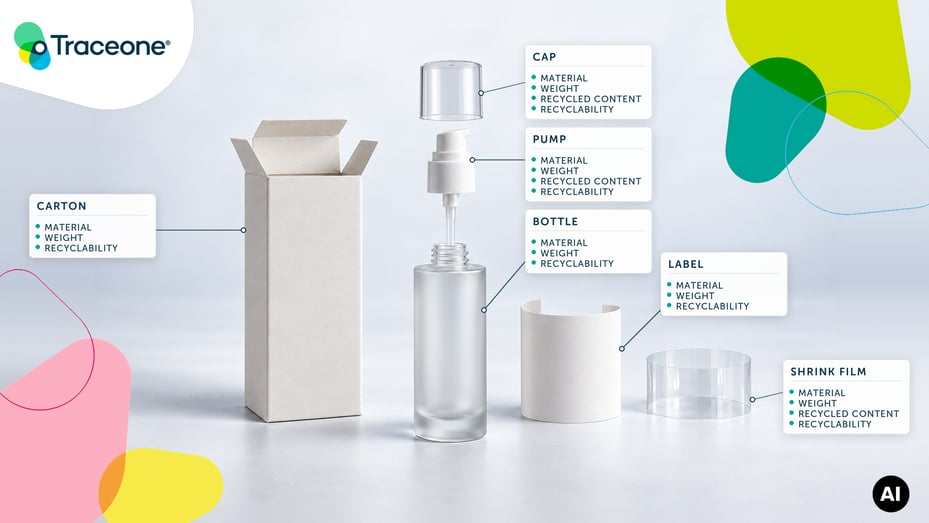
Three details make this harder than it sounds for beauty. Every component counts, not only the jar or bottle: the carton, the pump, the cap, the label and the shrink film each have their own material and weight to report, although state-specific exclusions can apply. Material categories differ between states, so the same component can be classified differently in Oregon, Colorado or Washington. And fees can vary with recyclability and recycled content, so the data does not just set the report, it sets the bill.
What packaging data does PPWR ask for?
PPWR, Regulation (EU) 2025/40, applies from August 12, 2026, and it judges the packaging itself before it can be placed on the EU market. The data behind that judgment is close to what US EPR needs, with more detail.
Recyclability is graded on design-for-recycling criteria from 2030, and on recycled-at-scale criteria from 2035. From January 1, 2038, packaging must be at least grade B to be placed on the market. Plastic packaging must meet minimum recycled content targets from 2030, with higher targets from 2040. From August 12, 2028, packaging must carry a harmonized label based on its material composition, to help consumers sort waste. Manufacturers must also hold technical documentation showing that the packaging meets the requirements.
What data do PPWR and US EPR have in common?
The same component-level facts, used for different purposes. For every pack, a brand needs:
- The list of components, from primary pack to carton, closure, label and film.
- The material of each component, including mixed materials and coatings.
- The weight of each component.
- The recycled content of each plastic component.
- The recyclability of each component and of the pack as a whole.
- The products that use the pack, and the markets and states where each product is sold.
In the EU, this data decides market access and also drives EPR fees in each Member State. In the US, it drives state EPR fees. The underlying packaging data is largely the same, but classification and aggregation rules can vary between the EU framework and individual US state programs.
Why do beauty brands find packaging data hard to manage?
Because the data is spread across teams and suppliers, and beauty packaging changes often. Packaging specifications sit with the packaging team, supplier declarations sit in inboxes, artwork sits with the design agency, and sales by state sit in another system. Beauty adds frequent launches, limited editions, gift sets and multi-component packs, each with its own bill of materials. Every change of supplier, material or pack size changes the data that both PPWR and US EPR depend on.
How can one packaging dataset cover PPWR and US EPR?
By storing packaging data once, at component level, and linking it to every product that uses it. In practice:
- Keep a packaging specification for every component, with material, weight, recycled content and the supplier’s declaration attached.
- Link each specification to the products and SKUs that use it, so a change to one component updates every pack it belongs to.
- Connect product data to sales by market and state, so the same record produces the EPR report for Oregon and the PPWR documentation for the EU.
- Tie artwork to the packaging specification, so the future harmonized PPWR label will match the materials actually used.
One record, kept current, serves both rulebooks. Two separate spreadsheets, one for Europe and one for the US, double the work and double the chance of a mismatch.
Frequently Asked Questions
Does US EPR apply to cosmetics packaging?
Yes. The state laws cover consumer packaging in general, and beauty packaging falls within that scope unless a specific exemption applies. Check each state’s exemption list for your product categories.
Is a beauty brand responsible for EPR if a contract manufacturer fills its products?
In most states, yes. The obligation usually follows the brand owner, not the filler or the packaging supplier.
When does PPWR apply?
PPWR applies from August 12, 2026. Its main packaging requirements phase in over the following years, with harmonized labels from August 12, 2028, recyclability criteria from 2030, and recycled content targets for plastic packaging from 2030 and 2040.
Can the same data be used for PPWR and US EPR?
Largely yes, if it is kept at component level. Both rely on the material, weight, recyclability and recycled content of each component, linked to where each product is sold. Material categories, calculation and aggregation rules can differ between the EU and individual US state programs.
Trace One helps beauty brands manage packaging, formula and regulatory data in one platform. Learn more about PPWR packaging compliance and cosmetics PLM.
Sources: Regulation (EU) 2025/40 (PPWR), EUR-Lex. Oregon DEQ, Plastic Pollution and Recycling Modernization Act. CalRecycle, SB 54 Packaging EPR. Maine DEP, Stewardship Program for Packaging. Circular Action Alliance, Maine. Minnesota Pollution Control Agency, Extended producer responsibility for packaging. Washington State Legislature, Chapter 70A.208 RCW. Circular Action Alliance, Producer Reporting. EPR Atlas, U.S. Packaging EPR Laws by State. IntegrityNext, US Packaging EPR.