Posted By:
Danijel Radonjic
Hazardous materials move through the U.S. economy every day—by truck, rail, air, and water—supporting industries ranging from manufacturing to energy. But when incidents occur during transit, the consequences can be significant, including chemical spills, fires, environmental damage, and supply chain disruptions. Federal data shows that these incidents are not rare events; rather, they represent a persistent operational and regulatory challenge tied to the scale and complexity of modern logistics networks.
While the transportation of hazardous materials is governed by a detailed federal framework, incident data suggests that compliance gaps remain a consistent issue. Common factors include packaging failures, improper hazard communication, and errors in shipping documentation—issues that can arise at multiple points across the supply chain. As shipment volumes grow alongside industrial activity and e-commerce logistics, even small breakdowns in compliance can scale into broader safety and operational risks.
In response, regulators have taken steps to strengthen enforcement. The U.S. Department of Transportation (DOT), through the Pipeline and Hazardous Materials Safety Administration (PHMSA), increased maximum civil penalties effective in 2025, with fines exceeding $100,000 per violation and substantially higher penalties in cases involving injury or significant damage. These updates reflect an effort to reinforce accountability as hazmat transportation becomes more complex. Within this context, industry stakeholders increasingly point to digital compliance tools—such as Safety Data Sheet (SDS) management software—as a way to improve documentation accuracy, standardize hazard communication, and reduce the likelihood of violations during transit.
This analysis, conducted by Trace One, a provider of SDS, regulatory compliance, and PLM software for the chemicals, food and beverage, and cosmetics sectors, examines the current trajectory of hazardous materials transportation incidents, detailing their geographic distribution and overall impact.
Key Findings
-
Hazmat transit incidents are rising sharply. Driven by greater volumes of hazardous materials moving through U.S. supply chains, hazmat transit incidents have surged 84.8% since 2010, reaching 27,355 annual cases in 2025.
-
Highways drive most hazmat incidents. Highway transport accounts for 119,346 incidents from April 2021 to April 2026, far exceeding air, rail, and water, while corrosives and flammable liquids make up the majority of cases—concentrating risk along heavily traveled roadways.
-
Industry and geography shape risk distribution. Large industrial states like Texas, California, and Illinois report the highest total incidents, while smaller states such as Alaska, Kansas, and Connecticut see higher per-capita rates—highlighting how shipment volume, industrial activity, and geography all influence exposure.
-
Catastrophic events amplify damage totals. Ohio’s $920.8 million in damages during the 5-year period ending on April 1, 2026—nearly 30 times higher than any other state—is largely tied to the catastrophic East Palestine derailment. This highlights how a single large-scale incident can dominate multi-year financial impact.
How Are Hazmat Transit Incidents Trending?
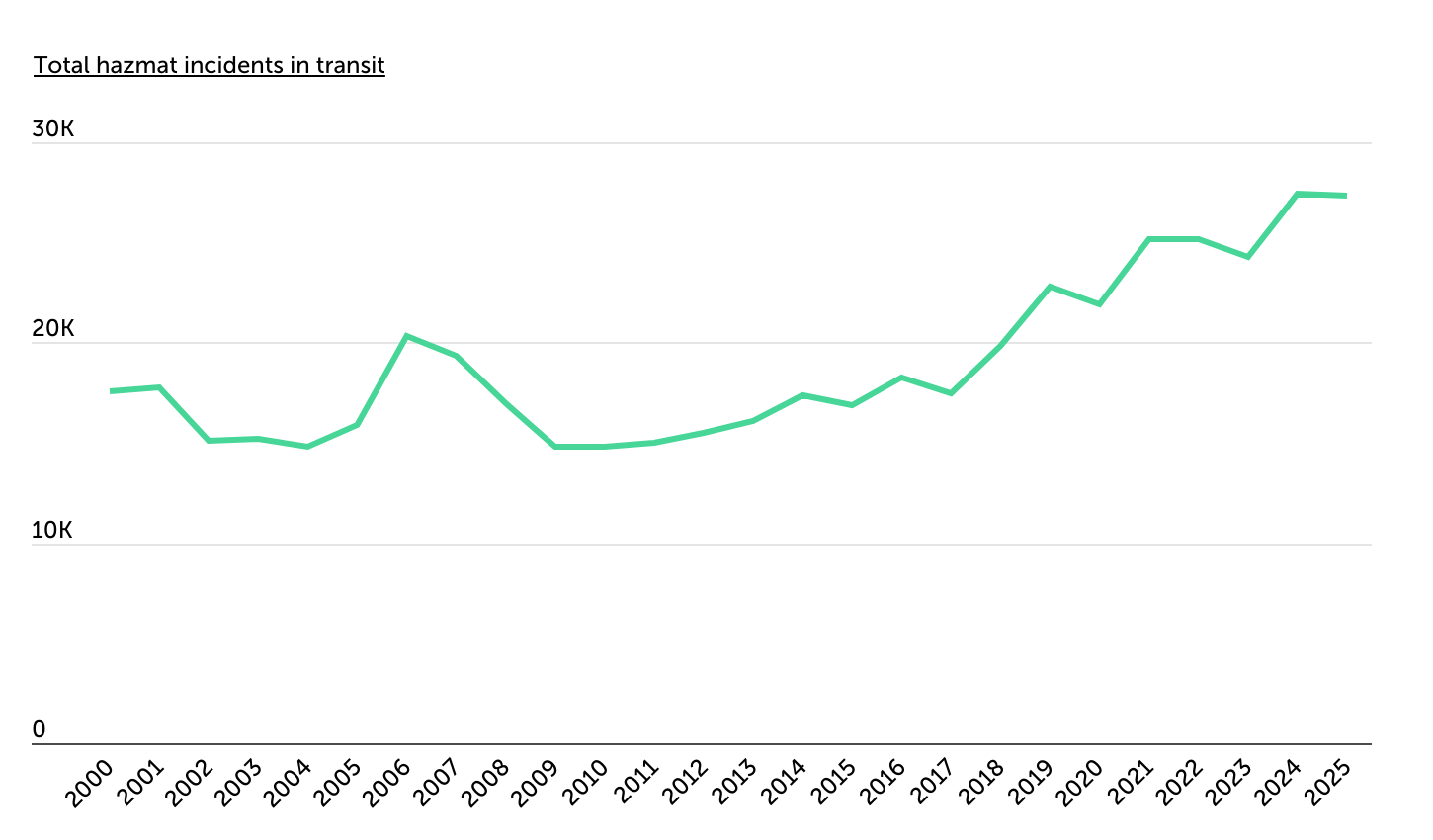
Hazardous materials incidents during transit have increased nearly 85% since 2010
Source: Trace One analysis of U.S. Department of Transportation data
Hazardous materials incidents during transit have increased sharply over the past 15 years, rising by 84.8% since 2010. Federal incident data shows that annual cases grew from 14,806 in 2010 to more than 27,355 in 2025, reflecting a sustained upward trajectory rather than isolated spikes.
This growth coincides with broader shifts in the U.S. logistics landscape, including expanding industrial output and increased freight movement—particularly via highways that often pass through densely populated areas. As more hazardous materials move through communities, the potential public impact of these incidents becomes more pronounced. Spills, fires, and exposure events can lead to road closures, evacuations, environmental contamination, and disruptions to local economies.
REDUCING RISK STARTS WITH BETTER DOCUMENTATION
Many hazmat transit incidents stem from preventable issues like incomplete paperwork, outdated classifications, or missing safety data sheets. Using SDS management software helps companies standardize hazard communication, maintain accurate documentation, and ensure critical safety information follows materials throughout the supply chain—reducing the likelihood of costly compliance failures in transit.

U.S. Hazmat Transit Incidents by Material and Transit Mode
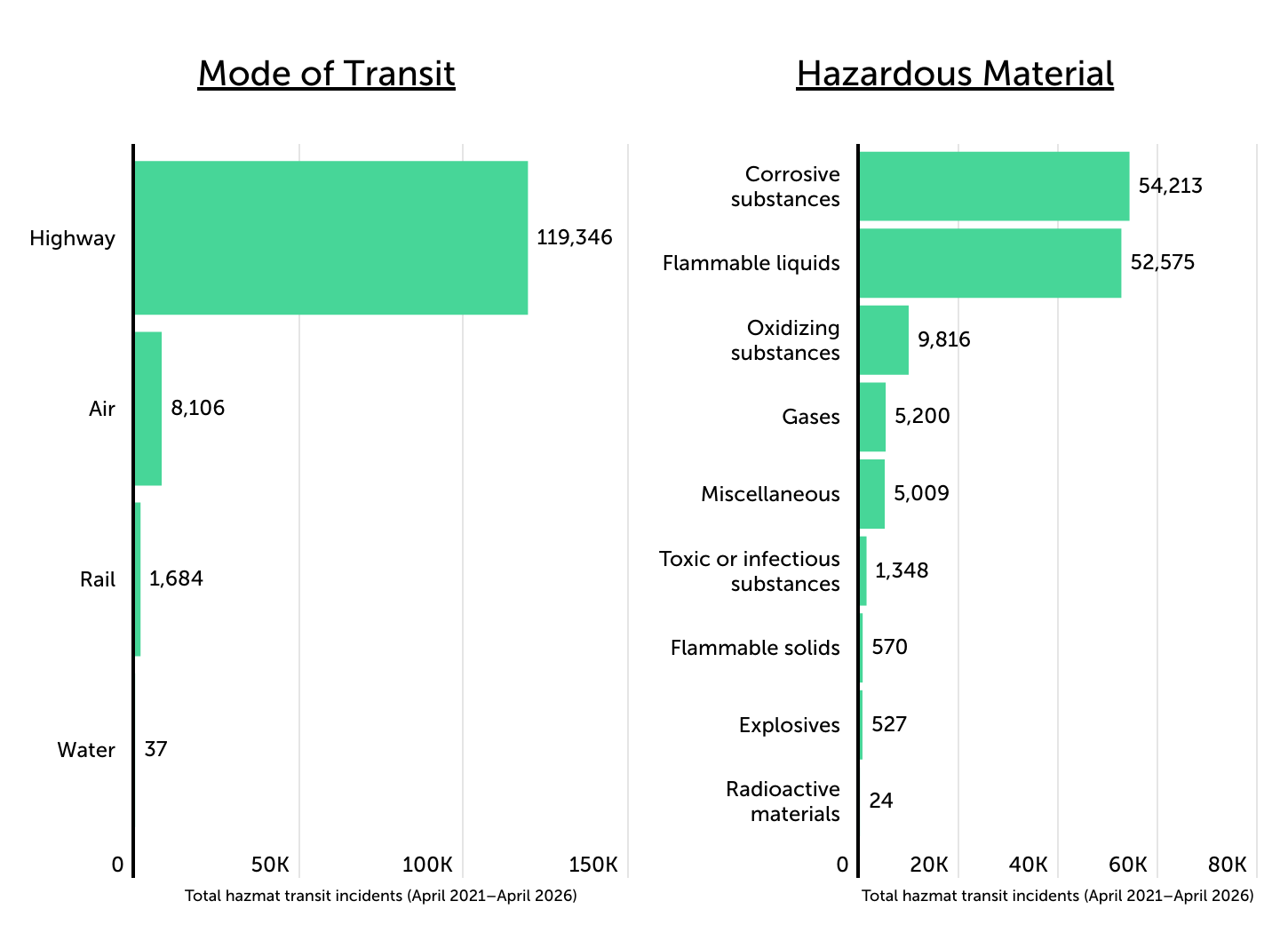
The vast majority of hazmat transit incidents involve highway shipments of corrosives and flammables
Source: Trace One analysis of U.S. Department of Transportation data
Hazmat incidents in transit are heavily concentrated in highway transportation, underscoring the central role of trucking in moving hazardous goods across the U.S. Between April 1, 2021 and April 1, 2026, highway shipments accounted for 119,346 incidents, far exceeding other modes such as air (8,106), rail (1,684), and water (37). This imbalance reflects both the scale and frequency of truck-based logistics, which serve as the backbone of domestic supply chains and often operate across densely populated corridors.
In terms of material type, incidents are similarly concentrated among a small number of commonly transported substances. Over the same period, corrosive materials (54,213 incidents) and flammable liquids (52,575 incidents) accounted for the majority of cases, with a notable drop-off to the next categories such as oxidizing substances (9,816) and gases (5,200). These materials are widely used across industries—from fuel distribution to manufacturing—making them among the most frequently transported hazardous goods and, consequently, the most commonly involved in transit-related incidents.
Where Are Hazmat Transit Incidents Occurring?
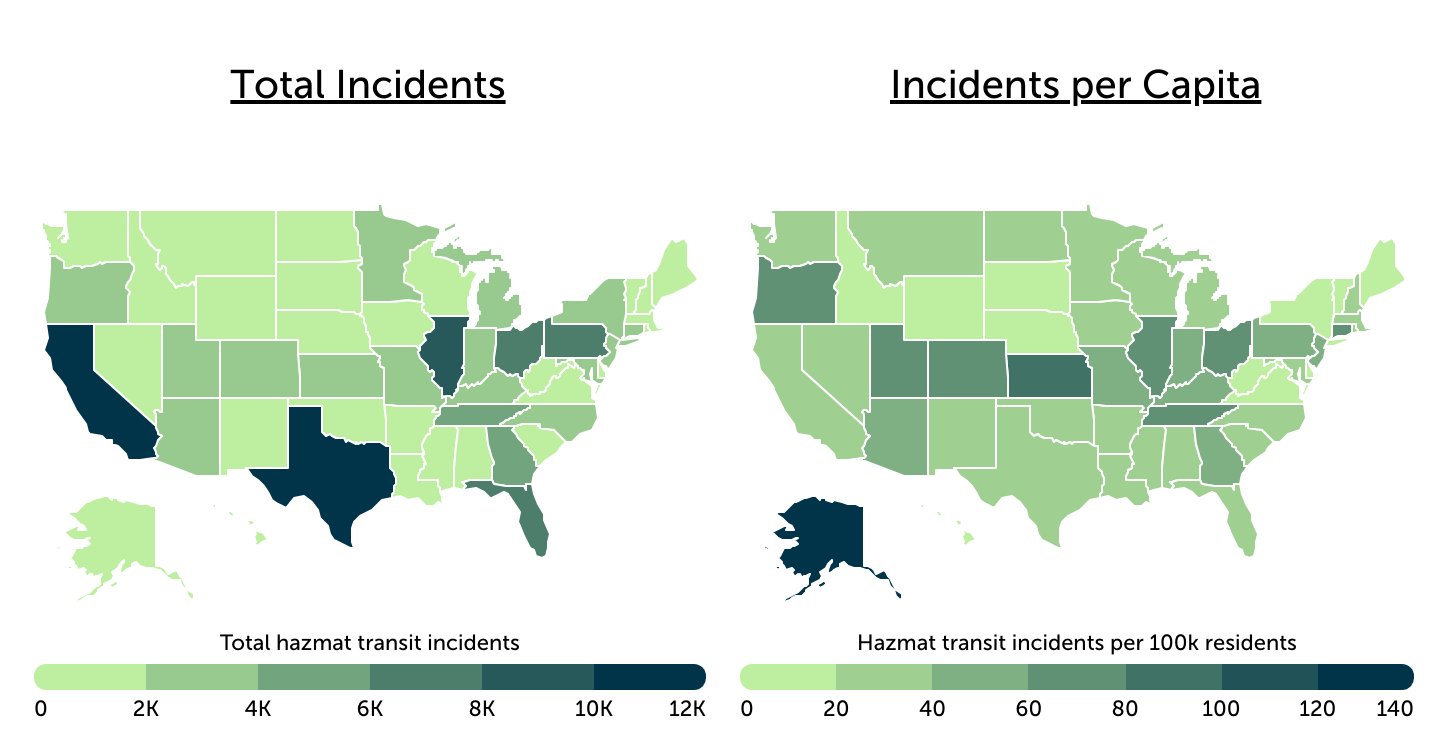
Industrial states see the most overall incidents, while Alaska leads on a per-resident basis
Source: Trace One analysis of U.S. Department of Transportation data
Hazmat transit incidents are not evenly distributed across the U.S., with clear geographic patterns emerging between total incident counts and per-capita rates. In absolute terms, large industrial and logistics-heavy states dominate. Between April 1, 2021 and April 1, 2026, Texas (11,748 incidents) and California (11,462) reported the highest totals, followed by Illinois (8,764), Ohio (7,991), and Florida (7,292). These states serve as major hubs for manufacturing, energy production, and freight movement, combining high shipment volumes with dense transportation networks that increase overall exposure to transit-related incidents.
When adjusted for population, however, a different pattern emerges. Alaska reports 127.7 incidents per 100,000 residents, the highest rate in the country, followed by states such as Kansas (96.6), Connecticut (78.2), and Tennessee (77.8). This shift reflects how less populous states—particularly those with long supply routes or significant industrial activity relative to their size—can experience elevated risk on a per-resident basis. The contrast between total incidents and per-capita rates highlights how both economic scale and geographic constraints shape where hazmat transit risks are most concentrated.
Managing Risk Beyond Documentation
As hazardous materials move through increasingly complex supply chains, risk doesn’t stop at documentation alone. Regulatory compliance software helps organizations manage everything from hazard communication and labeling to regulatory updates and cross-team coordination—creating a more unified approach to safety and compliance across operations.

Total Hazmat Transit Damages by State
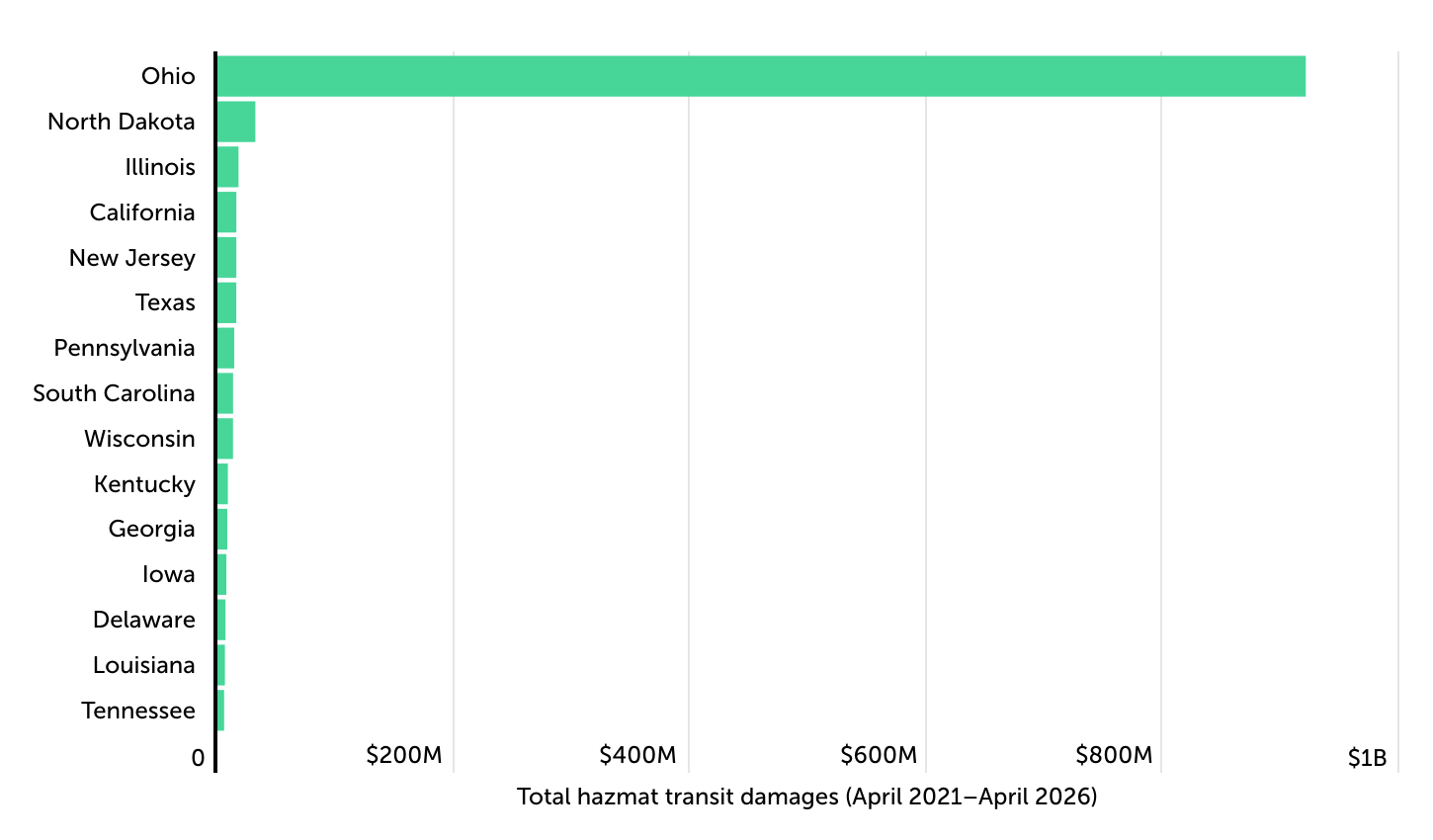
The East Palestine train derailment pushes Ohio's five-year damages to nearly $1B
Source: Trace One analysis of U.S. Department of Transportation data
While incident counts provide one measure of risk, total damages offer additional insight into the severity and impact of hazmat transit events. Damages are heavily concentrated in a small number of states, often driven by rare but catastrophic incidents rather than routine events. Ohio leads the nation with an astounding $920.8 million in total hazmat transit damages, far exceeding every other state. The next highest totals—North Dakota ($32.1 million) and Illinois ($17.8 million)—are an order of magnitude smaller, followed by California, New Jersey, and Texas with roughly $16 million in damages each.
Ohio’s outsized total is largely attributable to the February 2023 train derailment in East Palestine, a high-profile incident involving hazardous chemicals that triggered evacuations, long-term environmental remediation, and extensive federal and state response efforts. The scale of the event—both in terms of financial cost and public disruption—elevated Ohio’s five-year damage total to nearly 30 times that of the next highest state. Beyond Ohio, states like North Dakota and Illinois rank higher than larger states such as California and Texas due to their concentration of rail-based energy and chemical transport corridors. North Dakota’s crude oil shipments and Illinois’ position as a central rail hub increase exposure to higher-cost incidents, particularly those involving bulk materials, which can drive up total damages even when overall incident counts are lower.
For a complete breakdown of hazmat transit incidents for all 50 states, including totals, damages, serious incident counts, and the most common hazmat in transit incidents, see the tables below.
Full Results
Methodology
In order to determine the states with the most hazardous materials incidents in transit, researchers at Trace One used the latest data from the Department of Transportation’s Pipeline and Hazardous Materials Safety Administration. The researchers ranked states by the total hazmat transit incidents per 100,000 residents during the 5-year period of April 1, 2021 through April 1, 2026. Hazardous materials, as defined by the Secretary of Transportation, are those substances or materials that are capable of posing an unreasonable risk to health, safety, and property when transported in commerce. This includes hazardous substances, hazardous wastes, marine pollutants, elevated temperature materials, and more.
In the event of a tie, the state with the larger total number of hazmat transit incidents was ranked higher. For additional context, total hazmat transit damages, total hazmat transit incidents causing death or hospitalization, and the most common hazmat in transit incidents in each state were also calculated.