Summary

The FDA regulates approximately 80% of the US food supply (produce, seafood, dairy, beverages, packaged foods) using risk-based inspections. USDA FSIS oversees meat, poultry, and processed egg products through continuous on-site inspection. The jurisdictional thresholds differ by product type: for meat products, more than 3% raw meat or 2%+ cooked meat triggers USDA FSIS oversight. For poultry, 2%+ cooked poultry meat or 10%+ poultry components in combination. A single reformulation can shift your entire regulatory pathway.

Stakes are real: When a national meal-kit company added chicken to their pasta SKU without recognizing it crossed the USDA threshold, the reformulation triggered a 4-month delay and $180K in label reprints.


FSMA 204 Deadline Watch

DEADLINE ALERT FSMA 204 DEADLINE WATCH

The FDA’s Food Traceability Rule compliance date has been extended from January 2026 to July 20, 2028. Congress has directed the FDA not to enforce the rule before this date. However, the rule’s requirements remain unchanged.

Manufacturers on the Food Traceability List should implement Key Data Element (KDE) tracking now. Building end-to-end traceability takes months of coordination across your supply chain—not weeks.

Entity & terms Definitions

FDA: U.S. Food and Drug Administration. Regulates approximately 80% of the U.S. food supply, including packaged foods, beverages, dairy, seafood (except catfish), produce, and dietary supplements. Operates on risk-based facility inspections.

USDA FSIS: Food Safety and Inspection Service, a division of the U.S. Department of Agriculture. Oversees meat, poultry, and processed egg products through continuous, on-site inspection at regulated facilities.

FSMA 204: The FDA’s Food Traceability Rule requiring enhanced recordkeeping for high-risk foods on the Food Traceability List (FTL). Requires tracking Key Data Elements (KDEs) at critical points from source to distribution. Compliance deadline: July 20, 2028.

FALCPA: Food Allergen Labeling and Consumer Protection Act. Requires clear identification of major allergens on FDA-regulated food labels, either within ingredient lists or in a separate “Contains” statement.

Trace One: A Product Lifecycle Management (PLM) and regulatory compliance platform helping 9,000+ brands in Food & Beverage, Chemicals, and Cosmetics bring market-leading products to shelves faster—with compliance confidence that protects brand equity and accelerates retailer approvals.

BEST FOR: Trace One is best for food and beverage manufacturers and private-label retailers managing multi-category portfolios that span both FDA and USDA FSIS jurisdictions, particularly teams that need centralized PLM with embedded regulatory intelligence to prevent misclassification, reduce label rework, and accelerate compliant product launches. If you are evaluating food safety compliance software that handles dual-jurisdiction requirements, this guide explains the regulatory landscape Trace One is built to navigate.


Most teams assume the USDA–FDA divide is simple: USDA handles meat and poultry, FDA handles everything else. In reality, misinterpreting USDA vs FDA food regulation jurisdiction is one of the fastest ways to trigger costly relabeling, facility delays, rejected submissions, or even a full product recall.

Discover why food and beverage product recalls are rising worldwide, their impact on brands and how Trace One drives a recall-free future for manufacturers

If your company works with diverse or innovative food categories—from ready-to-eat meals to private-label SKUs—understanding where USDA FSIS authority ends and FDA oversight begins can determine how fast you launch, how much you spend, and how smoothly you scale.

When it comes to USDA and FDA oversight, the distinction is critical. The FDA regulates approximately 80% of the US food system, including most foods, beverages, dietary supplements, and food additives. It operates on a model of risk-based facility inspections. USDA FSIS oversees meat, poultry, and certain egg products, maintaining continuous, on-site oversight at processing facilities.

Some products combine ingredients that fall under both jurisdictions, like ready-to-eat meals featuring meat and grains. In those cases, you need to pay careful attention to both regulatory frameworks. That starts with understanding the differences and overlap between these two agencies.

FDA vs USDA jurisdiction rule: How products are classified?

At first glance, the rules for FDA and USDA FSIS jurisdiction are deceptively simple. In real company portfolios, it rarely is. With hybrids, reformulations, and exceptions, it becomes a high-stakes puzzle.

The FDA regulates roughly 80% of the US food supply, including produce, seafood, dairy, beverages, and packaged foods. Meanwhile, USDA FSIS oversees meat, poultry, and processed egg products.

But in practice, USDA vs. FDA food regulation reshapes your path to market when products contain ingredients that fall under both jurisdictions. The key thresholds involve meat and poultry content percentages, and they differ by product type.

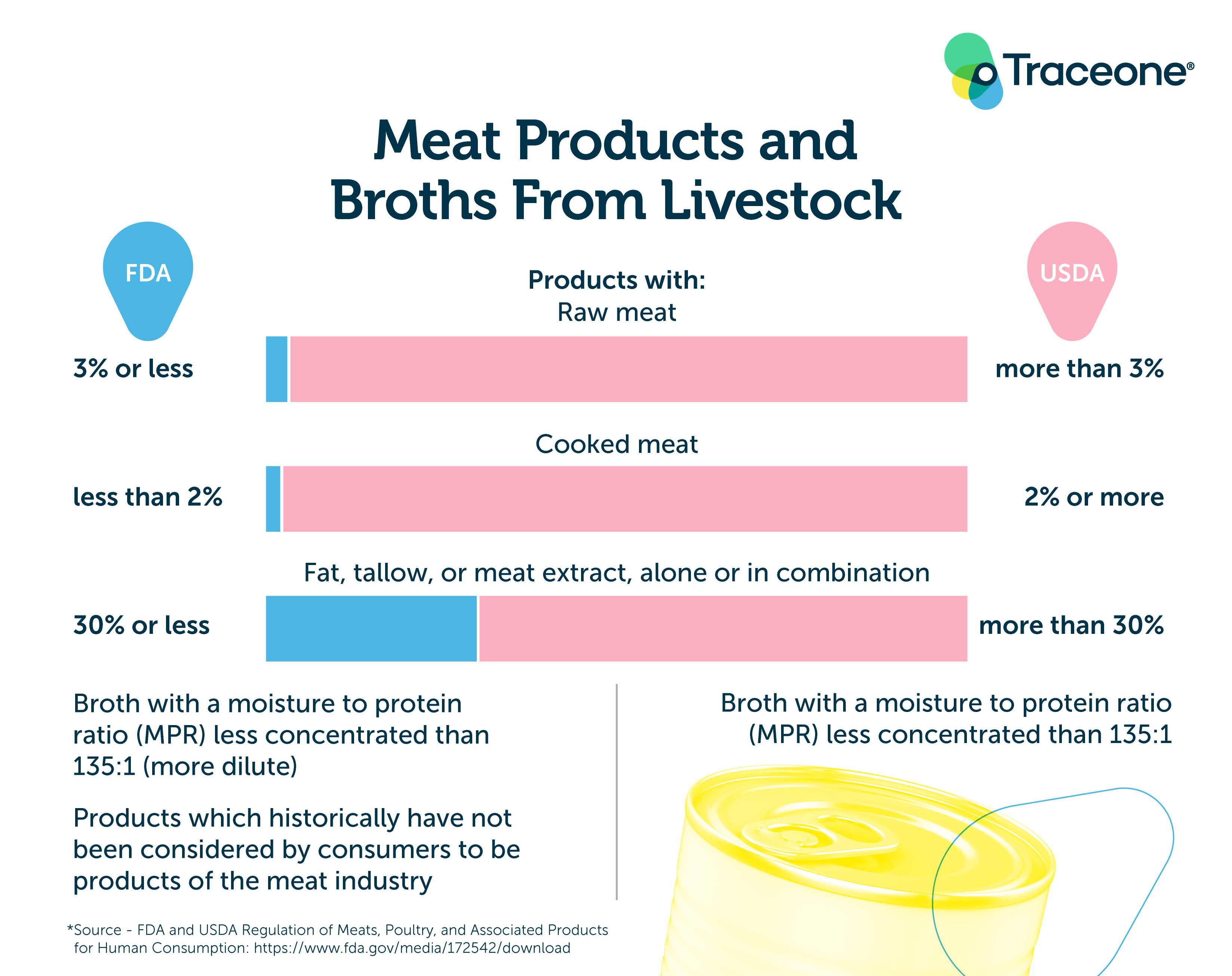
Meat Products and Broths from Livestock:

  • Raw meat: FDA regulates products with 3% or less. USDA FSIS takes over at more than 3%.
  • Cooked meat: FDA regulates products with less than 2%. USDA FSIS takes over at 2% or more.
  • Fat, tallow, or meat extract (alone or in combination): FDA regulates at 30% or less. USDA FSIS takes over at more than 30%.


*Source - FDA and USDA Regulation of Meats, Poultry, and Associated Products for Human Consumption: https://www.fda.gov/media/172542/download


FDAandUSDA_Pillar_Meat_02
FDAandUSDA_Pillar_Poultry_02

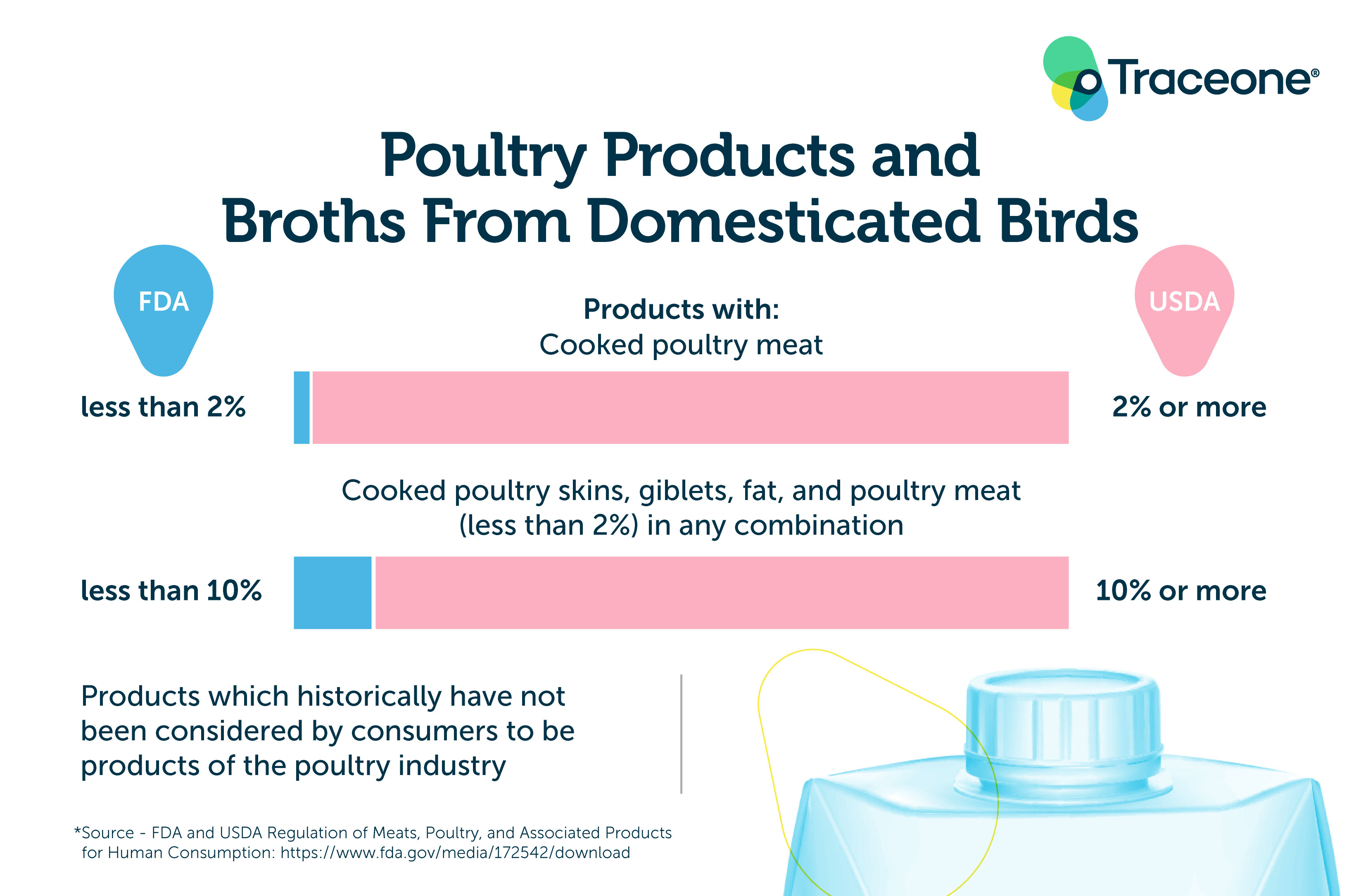
Poultry Products and Broths from Domesticated Birds:

  • Cooked poultry meat: FDA regulates products with less than 2%. USDA FSIS takes over at 2% or more.
  • Cooked poultry skins, giblets, fat, and poultry meat (less than 2%) in any combination: FDA regulates at less than 10%. USDA FSIS takes over at 10% or more.

Additional factors that determine jurisdiction include broth moisture-to-protein ratio (MPR) thresholds (135:1 as the dividing line) and whether products have historically been considered by consumers to be products of the meat or poultry industry.

 *Source - FDA and USDA Regulation of Meats, Poultry, and Associated Products for Human Consumption: https://www.fda.gov/media/172542/download 


 KEY TAKEAWAY  

For meat products: more than 3% raw meat or 2%+ cooked meat triggers USDA FSIS jurisdiction. For poultry: 2%+ cooked poultry meat or 10%+ poultry components in combination. These thresholds apply per-product—a single reformulation can shift your entire regulatory pathway, triggering facility re-approval, mandatory label pre-approval, and continuous inspection requirements.


There are also categorical divides associated with different kinds of food, which often cause confusion for manufacturers:

  • Pizza: Pepperoni pizza is USDA-regulated because of its meat content, while cheese pizza without meat belongs to the FDA.
  • Sandwiches: Closed-face sandwiches with meat fall under USDA FSIS oversight. Open-face varieties or meatless options are FDA-regulated.
  • Eggs: Shell eggs sold at retail are the FDA’s domain. Once they get processed into liquid, frozen, or dried egg products, USDA FSIS assumes authority.
  • Seafood exceptions: While most seafood is FDA-regulated, catfish is a USDA FSIS responsibility due to a congressional mandate.
  • Game meats: USDA FSIS regulates traditional livestock like beef, pork, and chicken, while game meats like venison and bison typically fall under the FDA, unless approved through state or USDA FSIS programs.

How Trace One helps: Trace One PLM centralizes product classification logic across your portfolio, ensuring each SKU follows the correct FDA or USDA FSIS pathway from formulation through commercialization. When a product’s formulation changes, linked compliance records update accordingly—so teams don’t discover a jurisdiction shift after the label is already printed.

If you produce hybrid products like ready-to-eat meals with both meat and FDA-regulated ingredients, understanding these boundaries is essential to avoid dual-agency scrutiny, labeling conflicts, and compliance gaps. Incorporating that knowledge early in product development helps you choose the right compliance pathway, avoid costly reclassification, and accelerate market entry. 


Who Regulates Which Categories? Quick Reference Table

Correct classification is the foundation of frictionless innovation. Before you finalize formulation, packaging, or artwork, identifying the right agency saves weeks of rework. 

 Food Category    Regulatory Authority  
Typical livestock meat (cow, swine, sheep, goat)   USDA FSIS
 Non-typical and game meat (antelope, bison, deer, elk, reindeer, and other unconventional livestock) FDA
 Typical poultry (chicken, turkey, ducks, geese, guineas, ratites, squab)  USDA FSIS 
 Non-typical and game poultry (grouse, pheasant, quail, wild turkey, wild ducks, wild geese)  FDA 
 Processed egg products (liquid, frozen, dried)  USDA FSIS 
 Shell eggs (retail)  FDA 
 Most fish and seafood  FDA 
 Catfish  USDA FSIS
 Dairy products  FDA 
 Produce  FDA 
 Beverages  FDA 
 Dietary supplements  FDA 
 Packaged or processed foods  FDA 

Each agency enforces distinct rules for facility registration, labeling formats, ingredient declarations, allergen statements, and inspection frequency. Misclassifying your product under the wrong agency invites avoidable risk that ripples across cost, timing, and brand trust: delayed product launches, failed inspections, labeling rejections, recall costs, and potential enforcement actions.

Manufacturers who proactively classify products correctly avoid expensive surprises and build scalable compliance systems that accommodate product innovation.

US Food Safety Regulation: Inspection and Enforcement

One of the most operationally significant distinctions in FDA vs USDA food regulation lies in how each agency conducts facility inspections. These differing approaches shape plant design, staffing requirements, audit readiness, and daily operations.


USDA vs FDA: Inspection and Enforcement

Continuous Inspection: USDA FSIS 

USDA-regulated facilities that process meat, poultry, and certain egg products operate under continuous, on-site inspection. USDA FSIS inspectors are physically present throughout production shifts, monitoring each stage from raw material receipt to finished product. This real-time oversight ensures immediate identification and correction of food safety issues before products leave the facility.

For manufacturers, that means designating a dedicated inspector space within the facility, maintaining real-time documentation of production processes, and setting immediate compliance expectations. This model is resource-intensive but provides high confidence that products meet safety standards at every step.

Risk-Based Inspection: FDA  

FDA-regulated facilities operate under a risk-based inspection schedule. Instead of maintaining a continuous presence, the FDA conducts inspections based on factors like product type, facility history, known hazards, and production scale. High-risk operations face more frequent inspections, and lower-risk facilities see inspectors less often.

This approach shifts responsibility onto manufacturers to maintain robust internal compliance programs. Strong preventive control systems, comprehensive recordkeeping, and audit-ready documentation are essential, since inspections can occur with little notice, and the FDA expects manufacturers to identify and mitigate hazards through proactive FSMA compliance.


KEY TAKEAWAY

USDA-inspected facilities need continuous documentation built into daily workflows. FDA-regulated manufacturers are responsible for maintaining perpetually audit-ready preventive control programs. Both models reward companies with disciplined, centralized documentation systems—and expose those relying on manual processes.

A global food and agriculture leader (160,000+ employees across 70 countries) replaced fragmented email-based compliance tracking with a unified platform. “The thing that fascinated us was having regulatory capability inside the tool, not having all these different emails and separate fragmented systems,” their product development leader explained. The result: formulation, labeling, and compliance documentation moving together in a single system—eliminating the manual handoffs that create compliance gaps during inspections.

How Trace One helps: For USDA-inspected facilities, Trace One PLM embeds real-time documentation into daily workflows, supporting continuous inspection readiness without manual record chasing. For FDA-regulated operations, Trace One supports FSMA preventive controls with audit-ready documentation and supplier data—so teams stay inspection-ready even between site visits.  

Book a 15-minute demo

Managing products across both FDA and USDA FSIS jurisdictions? See how Trace One customers centralize dual-jurisdiction compliance in a single PLM. 

Labeling Guidance: FDA Nutrition Facts vs. USDA FSIS Labels

Labeling is where jurisdiction errors become painfully expensive. The question of USDA vs. FDA labeling represents one of the most complex compliance challenges for food and beverage managers, especially companies that produce hybrid products or manage private-label portfolios across multiple categories. While both agencies aim to ensure accurate, transparent consumer information, their approaches to label approval, formatting, and content requirements differ.

Pre-Approval Requirements

USDA FSIS requires pre-approval of all labels before products can enter the market. Manufacturers need to submit label drafts to FSIS for review and formal approval—a process that can take weeks depending on their complexity. Any label changes require resubmission and approval.

On the other hand, the FDA does not require pre-approval for most food labels. Instead, manufacturers are responsible for ensuring compliance with FDA regulations before products reach the market. The FDA reviews labels reactively during inspections or in response to complaints.

If you manage product lines overseen by both the FDA and USDA FSIS, you will need to maintain two distinct labeling workflows to prevent bottlenecking launch timelines: one with built-in approval lead times and one that relies on proactive internal verification.


USDA vs FDA: Labeling Guidance

Nutrition Facts Panel Format

Both agencies mandate nutrition labeling, but the nutrition facts label differences reflect their regulatory priorities. FDA Nutrition Facts Panels follow a standardized format with serving size, calories, macronutrients, micronutrients, and percent Daily Values. The FDA enforces strict rules around added sugars, serving sizes, and dual-column labeling for multi-serving packages.

USDA FSIS labels often use simplified nutrition labeling or alternate formats, particularly for single-ingredient products. FSIS focuses heavily on safe handling instructions, inspection legends, and ingredient statements tailored to meat processing.

Allergen Labeling and Health Claims

The FDA’s FALCPA requires clear identification of major allergens, either within the ingredient list or in a separate “Contains” statement. USDA FSIS also requires allergen declaration, but placement and formatting may differ. Both agencies regulate health claims and nutrient content claims, requiring scientific substantiation. For hybrid products, manufacturers must navigate both agencies’ approval processes.


KEY TAKEAWAY
USDA FSIS requires mandatory label pre-approval before products enter commerce. FDA does not. Companies managing portfolios across both jurisdictions need two parallel labeling workflows—one with built-in approval lead times, one driven by internal verification—to prevent launch bottlenecks.


USDA vs. FDA Labeling: Quick Reference


 Labeling Element    FDA    USDA FSIS  
Pre-approval required   No: manufacturer responsibility   Yes: mandatory label approval before sale  
Nutrition Facts Panel   Standardized format, mandatory for most foods    Simplified or alternate formats allowed for certain products  
Allergen declaration   FALCPA requirements, “Contains” statement or ingredient list   Required but with format flexibility  
Health claims   Requires scientific substantiation and FDA approval   Requires FSIS approval, coordinates with the FDA  
Inspection legend   Not required   Required for USDA-inspected products  
Safe handling instructions   Product-specific   Mandatory for raw and partially cooked meat and poultry  


How Trace One Helps: Trace One PLM supports dual labeling workflows, separating USDA pre-approval timelines from FDA self-compliance processes to keep launches moving on schedule. The platform validates Nutrition Facts Panels, allergen statements, and claims against the correct agency rules—reducing label rejections and costly resubmissions.  

“Trace One Regulatory Compliance has made different international regulations much more accessible and easier to understand. It has cut the time I spend on international reviews in half and has truly been a lifesaver.”

Imbibe Inc.  


Edge-Case Scenarios Manufacturers Ask About

Manufacturers often ask who regulates food in the US. The answer frequently depends on nuances that seem arbitrary, but it has real compliance implications. Understanding FDA vs. USDA jurisdiction for edge-case products eliminates misclassification risk before it shows up as rework, delays, or rejected labels.  

Pepperoni Pizza vs. Cheese Pizza

Pepperoni pizza is USDA-regulated because it contains meat, regardless of cheese, sauce, or crust quantity. Cheese pizza is FDA-regulated as a general food product without meat. Manufacturers producing both items need to maintain separate compliance systems: one for USDA FSIS label pre-approval and continuous inspection for pepperoni, and another for FDA protocols around cheese.

Closed-Face vs. Open-Face Sandwiches

Closed-face sandwiches with meat or poultry fall under USDA FSIS jurisdiction when meat exceeds threshold levels: 2% or more cooked, more than 3% raw. Open-face sandwiches or meatless varieties are FDA-regulated. Physical structure and meat percentage determine agency oversight.

Shell Eggs vs. Processed Egg Products

Shell eggs sold at retail are FDA-regulated under the Egg Safety Rule. Processed egg products in liquid, frozen, or dried form are USDA-regulated, requiring continuous inspection. Egg producers selling both formats navigate two regulatory frameworks.

Catfish vs. Other Seafood

Catfish is under USDA FSIS jurisdiction due to congressional mandate. All other seafood is FDA-regulated with risk-based inspections. Catfish faces continuous USDA inspection, while other seafood follows FDA HACCP standards.

Game Meats vs. Traditional Livestock

Traditional livestock (beef, pork, chicken) is USDA-regulated. Game meats like venison and bison are typically FDA-regulated unless under state or voluntary USDA FSIS programs. Game meat producers can opt into USDA FSIS inspection for market access advantages.

These edge cases show why FDA and USDA FSIS jurisdiction isn’t always intuitive, and why quick assumptions get expensive. Meat content thresholds, historical legislation, and processing methods all influence oversight. Teams that document these edge cases early prevent cross-category compliance drift.

How Trace One helps: Trace One helps manufacturers document and operationalize these edge cases, so jurisdiction decisions are consistent, auditable, and scalable across product lines and regions.  

Traceability and Policy Watch: What’s Changing Through 2028

The landscape around USDA vs. FDA regulations continues to evolve rapidly, with new requirements reshaping how manufacturers approach compliance, traceability, and product development. Staying ahead of these changes is essential for operational readiness and market competitiveness.

FSMA 204: Food Traceability Rule

The FSMA 204 traceability rule represents one of the most significant compliance shifts for FDA-regulated manufacturers. The food traceability rule requires enhanced recordkeeping for high-risk foods on the Food Traceability List, including leafy greens, fresh-cut fruits, shell eggs, nut butters, and certain cheeses, with some exemptions.

Affected manufacturers are responsible for establishing detailed records tracking products from source to distribution, including Key Data Elements (KDEs) at critical tracking events. This requires robust digital systems capable of capturing lot codes, supplier information, and distribution data in real time.

The compliance deadline has been extended from January 2026 to July 20, 2028. Congress directed the FDA not to enforce the rule before this date, though the rule’s requirements remain unchanged. The FDA continues to release implementation resources, including traceability plan examples and supply chain guidance.

How Trace One Helps: Trace One enables FSMA 204 compliance by capturing KDEs digitally across suppliers, ingredients, and finished products—turning traceability into a built-in capability, not a last-minute scramble.  

Other Developments to Watch

  • USDA FSIS Pork and Poultry Streamlining (March 2025): Measures eliminating outdated administrative requirements and extending line-speed waivers. Particularly relevant for small and medium processors.
  • FDA Front-of-Pack Nutrition Labeling: Advancing requirements making key nutrient information (saturated fat, sodium, added sugars) immediately visible. Prepare for potential label redesigns and reformulation strategies.

Discover how the FDA's new front-of-package nutrition label rule presents opportunities for food brands to lead in transparency and health-conscious innovation with Trace One’s solutions

  • Cultivated Meat and Novel Proteins: FDA and USDA FSIS have established a joint framework for regulating cultivated meat, known as cell-cultured proteins. FDA oversees cell collection and growth, USDA FSIS handles production and labeling. This collaborative approach extends to plant-based alternatives and hybrid products. 

Book a 15-minute Demo

On the Food Traceability List? Wether the enforcement date lands in 2026 or 2028, building KDE tracking takes months-not weeks. 

Looking for local food regulatory updates? Explore our US Food Regulation News & Updates page.


How Trace One Helps Navigate USDA and FDA Compliance

The question of USDA FSIS and FDA compliance doesn’t have to slow your business down. Trace One helps food manufacturers and private-label retailers bring market-leading products to shelves faster—with compliance confidence that protects your brand and accelerates retailer approvals. As PLM for food manufacturers and private label compliance built for process industries, Trace One connects formulation, labeling, and regulatory intelligence in a single platform.

USDA vs FDA: how Trace One helps


Trace One PLM: Product Lifecycle Management

Trace One PLM unifies product data, specifications, and regulatory requirements into a single source of truth that withstands both FDA audits and USDA continuous inspection. Whether managing FDA-regulated beverages or USDA-inspected meat products, Trace One tools ensure your formulations, ingredients, and supplier information remain accurate and audit-ready throughout the product lifecycle.

  • Centralized product data: All formulations, specifications, and compliance records in one system. No scattered spreadsheets, no version confusion.
  • Supplier compliance tracking: Track supplier certifications, ingredient specs, and audit records. Flag expiring certificates up to 90 days in advance.
  • Dual-jurisdiction labeling workflows: Separate USDA pre-approval timelines from FDA self-compliance processes within the same platform.
  • Product classification logic: Link regulatory authority, labeling rules, and inspection models to the right product record from formulation through commercialization.

Trace One Regulatory Compliance: Regulatory Intelligence

Trace One Regulatory Compliance provides the intelligence layer that keeps teams informed about what’s changing, where, and how it affects their products. Integrated with Trace One PLM, it gives manufacturers a complete picture from regulatory research through compliant product launch.

  • Food News Monitoring System (FNMS): 24/7 monitoring of regulatory changes across 173 countries in 50+ languages. Smart Alerts deliver personalized updates to your inbox so teams know about regulatory shifts as they happen.
  • Food Law Library (FLL): 37,000+ legal statutes covering food legislation across global markets. Teams research regulatory requirements for target markets before product development begins.
  • REGDATA®: 20,000+ global restricted substances database with 1 million+ additive usage limits, 900,000+ pesticide residue records, 40,000+ flavoring regulation conditions, and 16,000+ contaminant limits. Instant go/no-go assessments on product formulations.


A Top 5 global dairy company ($20B+ revenue, 30% market share in its home region) saved the equivalent of 13 full-time employees annually—7,200 hours—on regulatory data collection alone after implementing Trace One Regulatory Compliance. The platform reduced their time-to-market by 50% while maintaining compliance across multiple jurisdictions.

“Regulatory compliance is at the heart of the tool because that’s where we’re feeding in our product development cycle and bringing all of our professionals into a place where they can collaborate.” Product Development Leader, Global Food & Agriculture Company

Book a 15-minute Demo

How many of your SKUs are one reformulation away from a jurisdiction change? See how Trace One customers centralize FDA and USDA FSIS compliance in a single platform.

USDA vs. FDA Regulation FAQs

What is the difference between the FDA and USDA FSIS in food regulation and safety?

The FDA regulates approximately 78–80% of the US food supply, including produce, seafood, dairy, beverages, and packaged foods, using risk-based inspections. The USDA’s Food Safety and Inspection Service (FSIS) oversees meat, poultry, and processed egg products through continuous on-site inspection. Each agency enforces distinct labeling, facility registration, and compliance requirements.  

Who approves food labels in the US?

USDA FSIS requires mandatory pre-approval of all labels for meat, poultry, and processed egg products before they can enter commerce. The FDA does not require pre-approval for most food labels. Instead, manufacturers are responsible for ensuring compliance with FDA regulations before products reach the market. The FDA initiates reactive reviews during inspections.

What is FSMA 204, and when is the compliance deadline?

FSMA 204 is the FDA’s Food Traceability Rule that requires enhanced recordkeeping for high-risk foods like leafy greens, fresh-cut fruits, shell eggs, nut butters, and more. Manufacturers must track Key Data Elements (KDEs) at critical tracking events from source to distribution. The compliance deadline has been extended to July 20, 2028, with Congress directing the FDA not to enforce the rule before that date.

Who regulates milk and dairy products?

The FDA regulates milk and all dairy products, including cheese, yogurt, butter, and ice cream. It oversees pasteurization standards, facility inspections, labeling requirements, and food safety protocols for dairy under the Food, Drug, and Cosmetic Act and the Pasteurized Milk Ordinance.

Are eggs FDA or USDA regulated?

Shell eggs sold at retail are FDA-regulated under the Egg Safety Rule, focusing on Salmonella prevention and safe handling. Processed egg products in liquid, frozen, or dried form are USDA-regulated and require continuous inspection. Producers selling both formats need to navigate two distinct regulatory frameworks and labeling systems.

Who regulates pizza?

Pizza regulation depends on toppings. Pepperoni pizza and other varieties containing meat or poultry are USDA-regulated, requiring label pre-approval and continuous facility inspection. Cheese pizza without meat or poultry is FDA-regulated as a general food product.

Who regulates sandwiches?

 USDA FSIS regulates closed-face sandwiches containing meat or poultry that exceed regulatory thresholds (2% or more cooked, more than 3% raw). Open-face sandwiches or meatless varieties are FDA-regulated. The physical structure and percentage of USDA-regulated ingredients determine which agency governs production, labeling, and inspection requirements.

What percentage of meat triggers USDA FSIS oversight?

The thresholds differ by product type. For meat products from livestock: more than 3% raw meat or 2% or more cooked meat triggers USDA FSIS jurisdiction. For poultry from domesticated birds: 2% or more cooked poultry meat, or 10% or more of cooked poultry skins, giblets, fat, and poultry meat in combination. Additional factors include fat/tallow/meat extract content (more than 30% triggers USDA) and broth moisture-to-protein ratios. Products below these thresholds are FDA-regulated.  

Is catfish FDA or USDA regulated?

Catfish is USDA-regulated due to a congressional mandate that transferred oversight from the FDA in 2016. It’s the only fish species under USDA FSIS jurisdiction, requiring continuous inspection like other meat and poultry products. All other seafood, including salmon, tuna, shrimp, and shellfish, remains FDA-regulated with risk-based inspections.

Do FDA and USDA FSIS collaborate on food safety?

Yes. The FDA and USDA FSIS collaborate on products falling under both jurisdictions—for example, ready-to-eat meals containing meat and FDA-regulated ingredients. The agencies coordinate through joint guidance documents, task forces, and data sharing on food safety issues, inspection practices, and outbreak investigations.

Our Customers Include

  • Auchan
  • 29-barilla
  • Cargill
  • OceanSpray
  • 37-mars-wrigley
  • logo_ferrero
  • 04-sensient
  • Brown–Forman_Logo
  • McCormick
  • 30-continentalmills
  • Ghirardelli
  • 35-lindt
  • Bacardi
  • innoncent drinks logo file
  • Ahold_Delhaize_Logo
  • Europastry Logo
  • carrefour-supermarket-logo
  • Glico_logo.svg
  • Moet Hennessy Logo
  • UNFI-1
  • Monoprix_logo.svg
  • Logo_Francap
  • Logo_Franprix_2015
  • Tesco_Logo.svg
  • AAK-1
  • ElectroDepot_Logo
  • Compliance-Cloud-Campari
  • naos png
  • Post Consumer Brands

Let’s Get in Touch