|
SDS
|
Chemical
|
Blogs
Posted By:
Danijel Radonjic
QUICK ANSWER |
|
Q: Which states have the most OSHA Hazard Communication (chemical) violations? Maryland leads the nation in workplace chemical-hazard violations, with 4,370 OSHA Hazard Communication citations from 2021 to 2025, a rate of 39.0 per 100,000 workers. Tennessee (3,159) and Michigan (2,113) follow in total count, while Alaska has the highest rate per 100,000 workers (44.7). Manufacturing and construction account for more than half (50.6%) of all HazCom violations nationwide. Source: Trace One analysis of OSHA and U.S. Bureau of Labor Statistics data |
Millions of U.S. workers handle, store, or work near hazardous chemicals every day—from cleaning solvents and industrial adhesives to flammable gases and corrosive substances. Without proper training, clear labeling, and accessible safety data sheets, employees may not fully understand the health risks they face, including respiratory illness, chemical burns, or fire and explosion hazards. Federal regulators and occupational health experts widely view hazard communication as a foundational component of workplace safety because it determines whether workers have the information needed to protect themselves.
To address these risks, the Occupational Safety and Health Administration (OSHA) established the Hazard Communication Standard (HazCom) in 1983. Often referred to as the “right-to-know” rule, the standard requires employers to classify chemical hazards, label containers, maintain safety data sheets, and train workers on safe handling procedures. Yet more than four decades after its adoption, HazCom remains one of OSHA’s most frequently cited workplace safety standards, indicating persistent compliance gaps across industries and regions.
To identify where U.S. employers are failing to warn workers about chemical dangers, Trace One—an SDS, regulatory compliance, and PLM software company serving the chemicals, food & beverage, and cosmetics sectors—analyzed OSHA enforcement data from 2021 through 2025. The analysis investigates which states and industries account for the most HazCom violations, as well as how these citation trends have evolved over time. For chemical and manufacturing companies, these violation patterns underscore why Safety Data Sheet management and Hazard Communication compliance can’t be handled manually — regulatory compliance platforms centralize SDS authoring, distribution, and audit trails across every facility.
Key Findings
-
HazCom violations remain widespread nationwide. OSHA recorded 36,984 Hazard Communication violations from 2021–2025, equal to 5.6 violations per 100,000 workers.
-
Maryland leads the nation in total HazCom violations. There were 4,370 violations during the 2021–2025 period, equal to 39.0 violations per 100,000 workers, one of the highest rates in the country.
-
Manufacturing and construction account for half of all HazCom violations. Manufacturing recorded 10,021 violations and construction reported 8,678, together making up 50.6% of all HazCom citations nationwide during the five-year period.
-
Inspection rates vary significantly by industry. The construction industry is by far the most highly-inspected sector, accounting for 42.8% of all inspections.
-
HazCom violations have declined substantially since their peak. Citations reached 37,134 in 1989 and fell to 6,130 in 2025, declining 83.5% over that period.
Which Industries Have the Most Hazard Communication Violations?
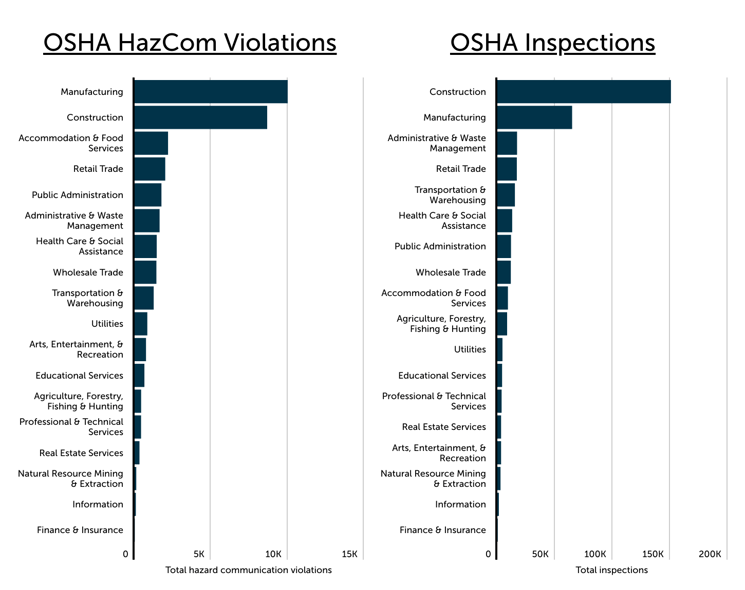
The manufacturing and construction industries account for more than half of all HazCom violations in the U.S.
Source: Trace One analysis of Occupational Safety and Health Administration (OSHA) data
HazCom violations are heavily concentrated in a small number of industries. From 2021 to 2025, the manufacturing industry recorded 10,021 violations—the highest total of any sector—followed by the construction industry with 8,678 violations. Together, these two sectors account for 50.6% of all HazCom violations nationwide during the five-year period. The next tier of industries reported significantly lower totals, including Accommodation & Food Services (2,189 violations), Retail Trade (2,005), and Public Administration (1,756), while sectors with less frequent exposure to chemical hazards, such as Finance & Insurance (13) and Information (81), recorded comparatively few citations.
Inspection totals provide additional context. OSHA does not inspect workplaces solely on a fixed schedule. Instead, the agency prioritizes inspections based on imminent danger situations, severe injuries or fatalities, and formal complaints—many of which originate from employees or labor representatives. In addition, 22 states and jurisdictions operate OSHA-approved State Plan programs that conduct their own inspections and share enforcement data with federal OSHA.
From 2021 to 2025, OSHA conducted 150,832 inspections in construction, more than twice the 64,971 inspections in manufacturing, reflecting construction’s size and risk profile. Yet despite this heightened scrutiny, only 2.5% of construction inspections resulted in at least one HazCom violation—one of the lowest rates among major industries. By contrast, 8.8% of manufacturing inspections led to a violation, suggesting that while construction is inspected more frequently, manufacturing inspections are more likely to uncover HazCom deficiencies.
Closing the Hazard Communication Gap |
| Despite decades of enforcement, thousands of Hazard Communication violations are still issued each year—often tied to missing or outdated Safety Data Sheets. Implementing SDS management software helps organizations centralize chemical inventories, automate updates, and ensure workers always have access to accurate hazard information—reducing compliance gaps that can lead to costly OSHA citations. |

Where Are Hazard Communication Violations Occurring?
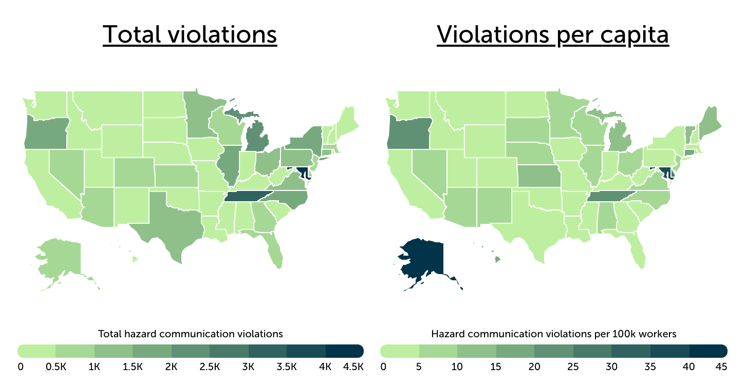
Maryland leads the U.S. in HazCom violations with 4,370 from 2021 to 2025
Source: Trace One analysis of Occupational Safety and Health Administration (OSHA) and U.S. Bureau of Labor Statistics data
HazCom violations are not evenly distributed across the country. Maryland recorded the most violations (4,370), followed by Tennessee (3,159) and Michigan (2,113)—states with substantial manufacturing and construction activity, the two industries that account for more than half of all HazCom citations nationwide. Michigan and Tennessee rank among the nation’s leading manufacturing states, particularly in motor vehicle production and advanced manufacturing.
Maryland’s elevated totals align more closely with its significant construction sector, supported in part by defense-related infrastructure spending and federal contracting around the Washington, D.C. region, where the federal government is a major economic driver.
When adjusted for workforce size, the geographic landscape shifts. Alaska records the highest rate at 44.7 HazCom violations per 100,000 workers, followed by Maryland (39.0) and Delaware (26.5), while Tennessee (22.2) and Oregon (21.5) also rank among the highest on a per-worker basis. Because OSHA inspections are often complaint-driven or targeted rather than uniformly distributed across all workplaces, measuring violations on a per-worker basis provides a clearer view of enforcement intensity relative to a state’s labor force size. In smaller states such as Alaska and Delaware, concentrated industrial activity within a relatively small workforce can translate into elevated violation rates, even when total citation counts are lower than those in larger manufacturing states. Conversely, a populous state like California with a vast and diverse workforce only has 0.3 HazCom violations per 100,000 workers.
Stronger Systems, Safer Workplaces |
| Managing chemical dangers, training, and safety data can be overwhelming across multiple sites. SDS software centralizes this information, streamlines reporting, and ensures policies stay current—helping companies proactively prevent Hazard Communication violations before they occur. |
How Are Hazard Communication Violations Trending?
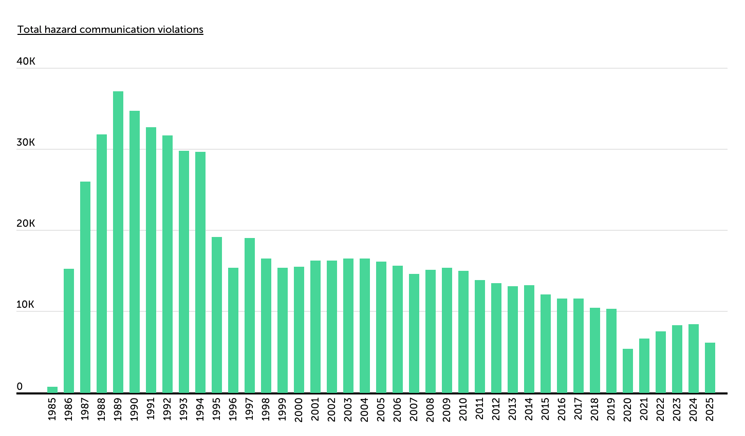
After peaking in 1989, HazCom violations have been declining ever since
Source: Trace One analysis of Occupational Safety and Health Administration (OSHA) data
HazCom violations peaked at 37,134 citations in 1989, shortly after OSHA’s Hazard Communication Standard—first issued in 1983—was fully implemented and expanded to cover most private-sector employers. The rule was adopted to address widespread worker exposure to hazardous chemicals without consistent labeling, safety data sheets (SDS), or training requirements. Aside from a pronounced decrease in 1995—when the Clinton administration shifted OSHA to emphasize cooperative programs and reduce regulatory burden—annual HazCom violations remained relatively flat through the early 2000s.
More recently, 6,130 HazCom violations were recorded in 2025, representing a decline of 83.5% from the 1989 peak. While enforcement levels remain far lower than the decades prior, thousands of citations are still issued annually. The broader adoption of digital compliance systems—including automated Safety Data Sheet (SDS) management platforms that centralize chemical inventories, update hazard classifications, and standardize labeling—has likely contributed to improved documentation accuracy and regulatory alignment, helping large employers reduce compliance gaps over time.
To identify where these compliance gaps persist today, researchers at Trace One analyzed the latest OSHA compliance data to break down results for all 50 states and Washington, D.C. below. For more information, refer to the Methodology section.
Full Results
Methodology
The data used in this study is from OSHA’s Enforcement Data and the U.S. Bureau of Labor Statistics’ Current Employment Statistics. To determine the states where U.S. employers most frequently fail to warn their workers about chemical dangers, researchers at Trace One analyzed and ranked states based on their total HazCom violations per 100,000 workers from 2021 through 2025. Violations were considered to be HazCom-related if the enforcement record referenced OSHA’s 1910.1200 standard and any of its subsections. For additional context, the total HazCom violations, share of inspections with a HazCom violation, total HazCom violation penalties, the most common HazCom violation, and the most common industry for HazCom violations were calculated for each state.