How Does AI Speed Up Time to Market?
|
PLM
|
AI in PLM
Posted By:
Federico Fontanella, PMP
AI speeds up time to market by removing the slowest manual work in product development: typing in supplier data, searching for regulations and hunting for information across systems. It works best inside the PLM, where product data already lives, with people accountable for the outcome and in control of the decisions that matter most.
Summary
- The biggest time savings today come from four tasks: extracting supplier data, verifying supplier certificates, regulatory research and finding information.
- Generating complete formulas and predicting supply chain disruptions are emerging capabilities that still need strong validation and expert oversight.
- AI inside the PLM works on your own data and permissions. Generative AI does not need to be trained on your data to be useful.
- Start with the most manual task, check your data and your vendor's data commitments, and measure time saved.
Why is time to market so hard for manufacturers and retailers?
Launching a product faster brings revenue sooner and puts you ahead of competitors. Speed alone is not enough, though. A product that fails a compliance check or needs a recall costs far more than the time saved.
For manufacturers in food and beverage, cosmetics and personal care, and specialty chemicals, and for retailers developing private label products, the delays usually come from the same places:
- Teams spread across sites and functions. R&D, quality, regulatory and packaging teams work in different places and different systems.
- Data locked in documents. Supplier specifications arrive as PDFs, scans and spreadsheets, and someone has to type them in.
- Regulations that differ by region. Every market has its own rules, in its own language, and the rules keep changing.
- Long approval chains. Each change needs sign-off from several departments.
- Back-and-forth with suppliers. Retailers wait for suppliers to send complete specifications and certificates, then check them line by line, often over several rounds of corrections.
None of these delays come from a lack of expertise. They come from manual work around the expertise. That is exactly where AI helps.
Where does AI save time in product development today?
Four tasks show the clearest time savings today, because they are repetitive, data-heavy and slow when done by hand.
How does AI speed up supplier and raw material data entry?
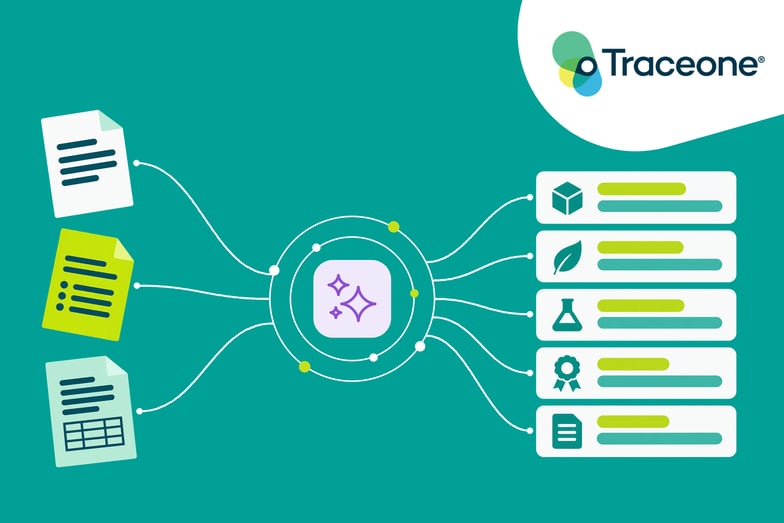
Raw material onboarding can mean reading and typing data from thousands of pages of supplier documents. AI reads those documents, whatever the format, extracts the relevant information and maps it to the right fields in the PLM. Teams spend less time on data entry, make fewer typing errors and get usable data into the system faster.
How does AI cut regulatory research time?
Regulatory managers often spend hours searching rules that differ by country and language. With an AI regulatory assistant, they ask a question in everyday language. The assistant asks clarifying questions and points them to the relevant regulations. In Trace One PLM, the assistant draws only on validated regulatory content, including the Food Law Library, not on the open web.
How does AI speed up supplier approvals for retailers?
Retailers developing private label products need certificates and specifications from every supplier. In Trace One PLM for retailers, AI extracts the information from supplier certificates, fills in the right fields and marks each certificate as verified against its source document. Quality teams spend less time checking and chasing suppliers.
How does AI help teams find information faster?
Traditional search means knowing which filters to set before you start. With AI, anyone can ask the system a question in plain language and get an answer, without building a report or asking a specialist for help.
Key Takeaway
The fastest time-to-market gains from AI today come from data extraction, certificate verification, regulatory research and search. These are the manual tasks that slow down every product launch.
What are the limits of AI in product development today?
AI is moving fast, so the useful line is not what AI can never do. It is which capabilities are mature and reliable for enterprise use today, and which are still emerging and need stronger validation:
- Generating complete formulas. AI can support formulation work today. Generating a complete, compliant, production-ready formula is still emerging and needs strong validation by experts.
- Predicting supply chain disruptions. Spotting early signals across large data sets is promising. Acting on them still takes people who know the suppliers and the markets.
- Critical decisions. AI outputs can be incomplete or wrong. Critical, high-risk decisions stay under explicit human control. Lower-risk tasks can increasingly run automatically, within set rules, permissions and exception thresholds.
The practical test for any AI feature: is it live today, on your own data, with clear rules for when a person reviews the result?
Key Takeaway
AI amplifies expertise. It does not replace it. People stay accountable: experts focus on critical decisions, exceptions and oversight, while AI handles more of the routine work around them, within clear rules.
Why does AI work better inside PLM than in generic AI tools?
Generic AI tools are built for any topic. Some can now connect to company data, but they do not understand how product data fits together: which ingredients go into which formulas, which specifications apply in which markets, and which regulations apply to each product.
AI inside the PLM works differently:
- It understands connected product context. It works with product structures, formulas, ingredients, suppliers, specifications, markets and regulations, and the links between them. Trace One is building a semantic layer that maps how product data, suppliers, markets and regulatory requirements relate to one another, so AI agents can reason across the product lifecycle rather than treating each document or field in isolation.
- It follows your permissions. Each user sees only what they are allowed to see, as in the rest of the system.
- Generative AI does not need to be trained on your data. AI assistants that answer questions or extract data use your data at the moment you ask. They do not need to learn from it in advance. At Trace One, customer data is not used to train public AI models.
- Predictive AI is different. Other types of AI, such as predictive models for formula simulation, can be trained on a company's own data, so results reflect that company's products and can be explained.
Key Takeaway
AI in PLM is useful because it understands connected product context: formulas, ingredients, suppliers, specifications, markets and regulations, within each user's permissions.
How do you start using AI to speed up time to market?
- Start with your most manual task. Supplier data entry and regulatory research are good candidates, because the time saved is easy to see.
- Check your data first. AI works on the data you have. Clean, connected product data gives better answers.
- Check your vendor's data commitments. Ask how your data is used, where the AI runs and whether it follows your permissions. See the questions to ask an AI-PLM vendor.
- Measure the time saved. Time the task before and after, so the gain is real and not assumed.
Frequently asked questions about AI and time to market
Does AI replace R&D and regulatory experts?
No. AI removes manual tasks such as data entry and searching, so experts spend more time on product decisions. People stay accountable, and critical decisions stay under expert control.
Which AI tasks save the most time in product development?
Today, the clearest savings come from extracting data from supplier documents, regulatory research in everyday language, and finding product information without complex searches.
Can AI create a product formula on its own?
This is still an emerging capability. AI can support formulation work today, but generating a production-ready formula needs strong validation by experts.
Is AI in PLM trained on a company's product data?
It depends on the type of AI. Generative AI, such as assistants that answer questions or extract data, uses company data at the moment a user asks, without being trained on it. Predictive models, such as those used for formula simulation, are often trained on a company's own data so results fit its products. At Trace One, customer data is not used to train public AI models.
How should AI time savings be measured?
Time a specific task, such as onboarding one raw material, before and after AI. A measured gain on one task is more useful than an assumed gain across the whole process.
Learn more
See what AI can do in Trace One PLM today and how it protects your data: AI in PLM with Trace One.
About Trace One
Trace One is a global provider of AI-native Product Lifecycle Management (PLM) and regulatory compliance software for the food & beverage, cosmetics & personal care, and specialty chemical industries. With more than 30 years of industry expertise, the company helps over 9,000 brands worldwide develop, launch, and manage remarkable products faster. Purpose-built for formula-based product development, its platform connects the entire product lifecycle from ideation to launch, with integrated regulatory intelligence spanning 170+ countries. Learn more at traceone.com.